
By submitting this form you confirm that you agree to the storing and processing of your personal data by EvenUp as described in our Privacy Policy.
"*" indicates required fields
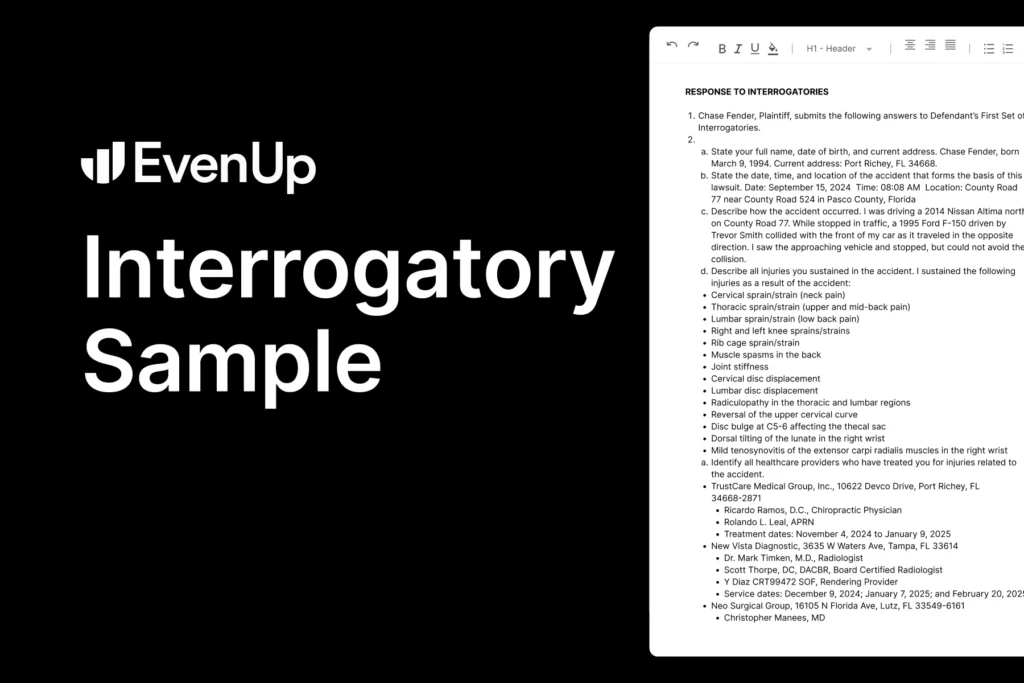
Explore these sample interrogatories examples against plaintiffs. They can help you understand common questions and types of answers that generate compelling discovery.
Interrogatories are written questions that one party sends to another during a lawsuit, and the receiving party answers them under oath.
Interrogatories can make or break your defense strategy in a personal injury case. The right questions lock the plaintiff into a sworn version of events early, exposing inconsistencies before you ever step into a courtroom.
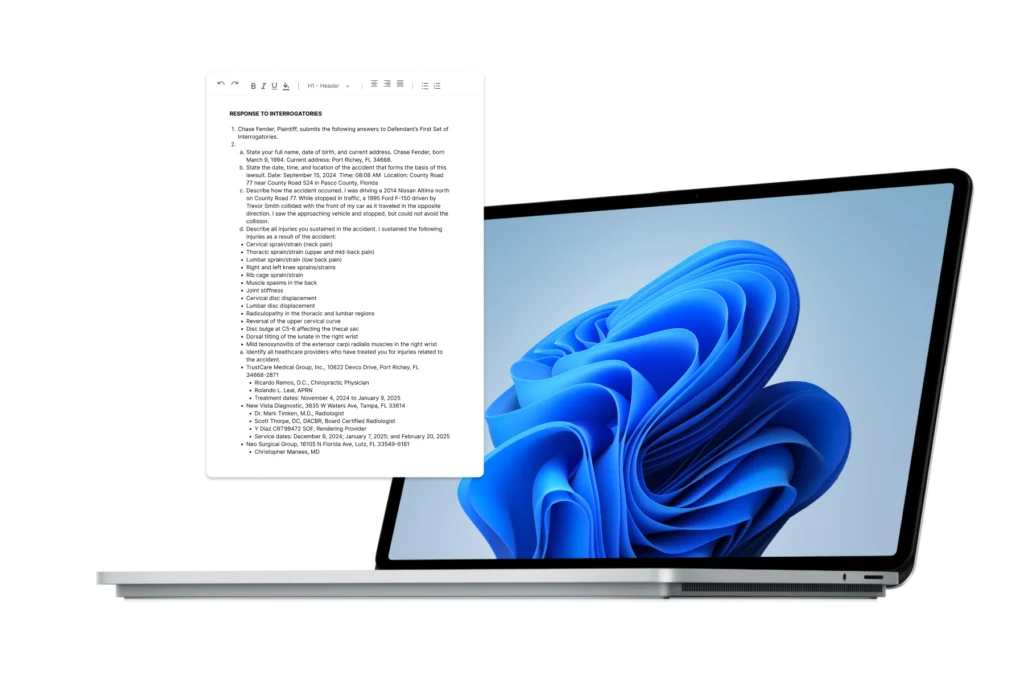
In personal injury cases, defense attorneys use interrogatories to gather the basics about the plaintiff—their identity, the specifics of their claimed injuries, what happened during the incident, who witnessed it, any statements made afterward, and the damages being sought. The answers help establish the factual foundation of the plaintiff’s case before trial.
Think of interrogatories as a way to get the plaintiff’s story on the record early. Unlike depositions, which happen face-to-face and can feel more confrontational, interrogatories give the responding party time to gather information and work with their attorney before answering.
A few terms worth knowing:
The discovery phase of litigation is all about exchanging information, and interrogatories are among the most efficient tools for that purpose. They can establish a timeline of events, identify witnesses, clarify the extent of claimed damages, and reveal pre-existing conditions that might affect the case.
Every set of interrogatories follows a predictable structure, though the specifics vary depending on whether you’re in federal or state court.
The document typically starts with a caption identifying the case, followed by a definitions section that clarifies terms used throughout the questions. After that come the instructions explaining how the plaintiff should respond, then the numbered questions themselves, and finally a signature block where the plaintiff verifies their answers under oath.
| Element | Federal Court (FRCP Rule 33) | State Court (Varies) |
| Question Limit | 25 including subparts | Often 25-40, some unlimited |
| Response Deadline | 30 days | Typically 30 days |
| Format Requirements | Written, under oath | Written, under oath |
State courts often have their own local rules, so checking the specific jurisdiction’s requirements before drafting saves time and avoids unnecessary objections down the road.
Auto accident cases are among the most common types of personal injury litigation. The sample questions below cover the essential areas that defense counsel typically explores when building a case.
These questions establish who the plaintiff is and their circumstances at the time of the accident:
Getting the plaintiff’s version of events on the record helps identify inconsistencies and potential defenses:
Medical information sits at the heart of most personal injury claims. These questions dig into the plaintiff’s treatment history:
Quantifying what the plaintiff claims to have lost helps evaluate the case’s overall value:
Knowing who might testify and what evidence exists allows for thorough preparation:
Some jurisdictions, particularly California, offer form interrogatories—pre-approved question sets that cover common issues in personal injury cases. Courts have already vetted the language, so plaintiffs have a harder time objecting to them.
Special interrogatories, on the other hand, are custom-drafted questions tailored to the specific facts of your case. They take more effort to prepare, but they allow you to explore details that standardized forms might miss entirely.
| Type | Best Used When | Limitations |
| Form Interrogatories | Starting discovery, covering standard issues | May not address case-specific facts |
| Special Interrogatories | Exploring unique circumstances, following up on specific claims | Subject to numerical limits, more likely to draw objections |
Many attorneys use both types together. Form interrogatories cover the basics, while special interrogatories address the particular issues that make each case unique.
Plaintiffs don’t always answer every question directly. Knowing the common objections helps you draft interrogatories that are harder to sidestep.
The plaintiff claims the question is unclear. Using precise language and defining key terms in your definitions section typically prevents this objection from gaining traction.
The plaintiff argues that answering would require unreasonable effort. Narrowing the time frame or scope of your questions often resolves the issue before it becomes a dispute.
The plaintiff asserts that the attorney-client privilege or work product doctrine protects the requested information. This objection is sometimes legitimate, though plaintiffs occasionally assert it more broadly than warranted.
The plaintiff objects that you’re asking for legal analysis rather than facts. Rephrasing questions to focus on factual information addresses this concern in most cases.
The plaintiff refuses to answer because your interrogatory set exceeds the jurisdiction’s limit. Counting subparts carefully during drafting prevents this problem entirely.
Verified interrogatory answers become powerful tools as the case moves toward trial. Because the plaintiff signs them under oath, any inconsistencies between their written responses and later testimony can be used for impeachment.
The responses also shape deposition strategy. If a plaintiff’s written answer seems incomplete or evasive, that topic becomes a natural area to explore more thoroughly during their deposition.
When a plaintiff provides inadequate responses, filing a motion to compel may be the next step. Courts generally expect good-faith efforts to resolve discovery disputes informally before ruling on such motions, so documenting your attempts to get complete answers matters.
Managing interrogatory responses alongside medical records, accident reports, and other case documents can quickly become overwhelming—especially for firms handling high volumes of personal injury cases.
AI-powered legal technology platforms help attorneys organize and analyze this information more efficiently. Tools like EvenUp’s Claims Intelligence Platform allow legal teams to cross-reference interrogatory responses with medical chronologies and other case materials, making it easier to spot inconsistencies and build stronger cases.
Firms looking to streamline their case preparation workflow can schedule a call to explore how technology might help.
Federal courts typically allow 25 interrogatories including subparts under FRCP Rule 33, while state courts set their own limits that often range from 25 to 40 questions. Parties can request court permission to exceed the standard limit if they demonstrate good cause.
Response deadlines depend on the jurisdiction, but plaintiffs generally have 30 days from the date of service to respond. Extensions are available through stipulation between the parties or by court order.
Yes. A plaintiff’s verified interrogatory answers are considered admissions and can be introduced at trial. They’re particularly valuable for impeaching a plaintiff whose testimony contradicts their earlier written responses.
Form interrogatories are standardized, pre-written sets of questions approved by courts (most commonly used in state courts like California). They cover common topics such as identity of witnesses, insurance coverage, medical treatment, and damages. Because they follow an official format, parties can use them without drafting custom questions, making discovery more efficient and predictable.
ChatGPT and similar tools use publicly available learning language models (LLMs). Anyone can use these general-purpose LLMs for many tasks. However, they may not have the depth needed for specialized tasks.