
By submitting this form you confirm that you agree to the storing and processing of your personal data by EvenUp as described in our Privacy Policy.
"*" indicates required fields
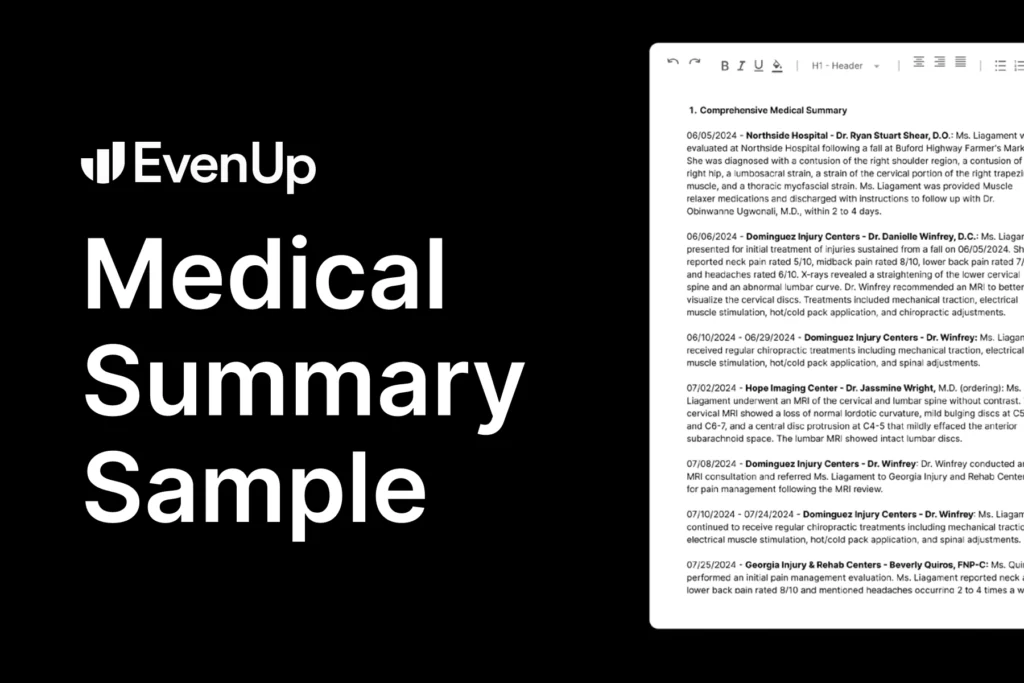
Medical record summaries for law firms distill a patient’s medical records into a clear, organized document. We’re talking hundreds or even thousands of pages from multiple providers. It’s critical to have a strong medical records summary template your firm can work from. That’s why we’re sharing a proven sample medical records summary for you to download and make your own.
For a personal injury case, a legal medical summary example typically covers the date of injury, how the incident happened, the diagnoses from treating physicians, a timeline of treatments, and where the patient stands today.
The format usually follows a SOAP structure (Subjective complaints, Objective findings, Assessment/diagnoses, and Plan/treatment), which helps attorneys and insurance adjusters quickly grasp the medical facts without wading through clinical jargon.
You can think of it as a translation tool. Medical records are written for healthcare providers, not lawyers. A legal medical summary bridges that gap by pulling out the details that actually matter for proving causation and calculating damages.
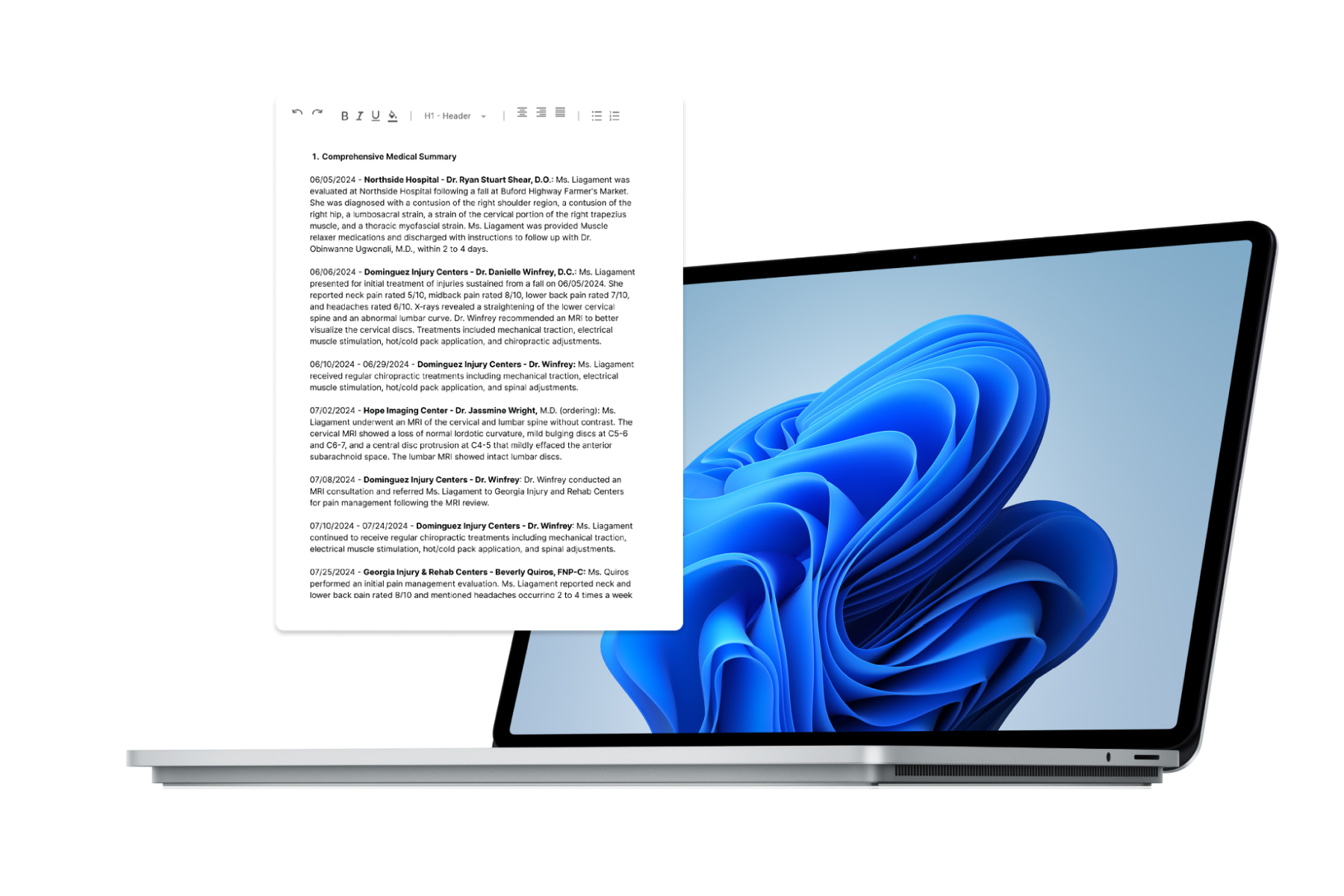
Medical chronologies are not interchangeable with medical record summaries for law firms. Each is a unique documents with distinct purposes. Knowing when to use each one saves time and makes case preparation more efficient.
A medical records summary for law firms organizes information by topic, provider, or injury type rather than by date. It reads more like a narrative—telling the story of how injuries affected the client’s life and what treatment looked like across different specialists. This format works well when you want to present a cohesive picture rather than a list of events.
A medical chronology, on the other hand, arranges every medical event in strict date order. It creates a timeline from the incident through the current treatment, making it easier to spot patterns, gaps in care, or inconsistencies that might arise during depositions.
The choice often comes down to where you are in the case. Chronologies tend to be more helpful early on—during discovery, when you’re still piecing together what happened and identifying missing records. Summaries work better later, especially when drafting demand letters or preparing for mediation, where narrative flow matters more.
A solid sample legal medical summary follows a consistent structure. Here’s what top personal injury firms typically include in theirs.
Start with the basics: patient name, date of birth, date of incident, and any case identifiers. This seems obvious, but missing or incorrect demographics create confusion when records get shared between parties.
List each injury claimed in the complaint alongside the corresponding diagnoses from treating physicians. Including ICD codes (the standardized diagnostic codes used in healthcare billing) adds precision and connects legal allegations directly to medical documentation.
Document each provider visit, the treatments rendered, and any medications prescribed. Include facility names and provider credentials—this information becomes critical if you later need to subpoena additional records or depose a treating physician.
Itemize past medical costs with specificity. Where future treatment is anticipated, note the basis for those projections. This section directly supports the damages calculation that drives settlement value.
Flag any incomplete documentation. Missing imaging studies, unsigned physician notes, or unexplained gaps in treatment can undermine a case if not addressed early.
Seeing an actual example often makes the format click. Below is a sample based on a typical auto accident case.
Patient: Jane Doe, DOB: 05/15/1985
Date of Incident: 02/09/2023
Incident Description: Motor vehicle collision at intersection of Main St. and Oak Ave. Client was rear-ended by commercial delivery vehicle while stopped at red light.
Alleged Injuries:
Treatment Summary:
Metro EMS transported the client from the scene to City Urgent Care on 02/09/2023. Initial presentation included neck pain, shoulder discomfort, and reported fogginess. X-rays came back negative for fractures.
The client followed up with Dr. Sarah Chen at Primary Care Associates on 02/14/2023. Dr. Chen ordered an MRI of the lumbar spine, which revealed a mild disc protrusion at L5-S1 on 02/17/2023. Physical therapy at Active Motion PT began 02/23/2023 and continued through 05/05/2023, totaling 18 sessions.
Neurologist Dr. Michael Torres confirmed the post-concussive syndrome diagnosis on 03/15/2023 following cognitive testing.
Medical Expenses:
Current Status: Client returned to work part-time on 04/28/2023. Ongoing symptoms include intermittent neck stiffness, arm tingling, and disrupted sleep.
Missing Records: Physical therapy discharge summary not yet received. Request sent 05/12/2023.
Notice how the example connects the incident directly to the injuries and treatment. Each provider visit has a date and purpose. The expenses are itemized with a running total. And the missing discharge summary is flagged rather than ignored—that kind of transparency matters when building credibility with adjusters.
Even experienced legal professionals run into obstacles when preparing these documents. Here are the most common ones.
A single personal injury case can generate thousands of pages across emergency rooms, specialists, imaging centers, and therapists. Reviewing everything manually takes significant time and increases the risk of missing something important buried on page 847.
Medical terminology is precise. Misinterpreting a diagnosis or procedure can change the entire narrative of a case. This gets especially tricky when records contain abbreviations, handwritten notes, or conflicting information from different providers.
Records requests don’t always return complete files. Identifying what’s missing—and following up before deadlines—requires systematic tracking. Otherwise, gaps in documentation can surface at the worst possible moment.
When multiple paralegals or reviewers work on the same case, quality can vary. Without standardized processes, one person’s summary might look completely different from another’s, which creates confusion for the attorneys relying on them.
The most efficient firms have moved beyond purely manual processes. Here’s what that looks like in practice.
Templates ensure every summary includes the same components, regardless of who prepares it. This consistency improves quality and makes it easier for attorneys to find information quickly—they know exactly where to look for diagnoses, expenses, or missing records.
Many leading firms now use AI tools to accelerate the initial review process. These platforms can extract key dates, diagnoses, and treatments from records in a fraction of the time manual review requires. EvenUp’s Claims Intelligence Platform, for instance, generates medical chronologies automatically while flagging potential gaps or inconsistencies for human review.
Even with technology assistance, human review remains essential. Top firms build in checkpoints where a second set of eyes verifies accuracy before documents go out. This catches errors that could undermine credibility with opposing counsel or adjusters.
A few principles consistently separate excellent summaries from mediocre ones.
Pick a structure—by provider, by injury, or by date—and apply it consistently across all cases. Switching formats mid-document creates confusion for anyone trying to follow along.
Not every clinical note is relevant to litigation. Focus on facts that establish causation, document the severity of injuries, and support damages calculations. The goal is clarity, not comprehensiveness for its own sake.
Cross-check every diagnosis, date, and provider name against the source records. Small errors—a wrong date, a misspelled provider name—can undermine credibility in ways that are hard to recover from.
OCR tools (optical character recognition, which converts scanned documents into searchable text), AI-powered summarization, and workflow automation all reduce the risk of human error while freeing up staff for higher-value work.
The volume of medical records in personal injury cases keeps growing. Firms that rely solely on manual review often find themselves choosing between thoroughness and efficiency—there’s only so much time in the day.
AI-powered tools eliminate that tradeoff. They handle the initial extraction and organization, allowing legal professionals to focus on analysis and strategy rather than data entry. The result is faster turnaround, fewer missed details, and more time for the work that actually requires human judgment.
Schedule a call to see how EvenUp’s Claims Intelligence Platform helps personal injury firms create accurate medical chronologies and summaries in less time.
Length varies based on case complexity and the volume of records involved. A straightforward soft tissue case might require only two to three pages, while a catastrophic injury case with years of treatment could run significantly longer. The goal is to be comprehensive without unnecessary detail.
Paralegals commonly prepare medical summaries under the supervision of an attorney. For cases involving disputed causation or complex medical issues, some firms bring in nurse consultants or medical experts to assist with interpretation.
Firms typically use a combination of case management systems for organization, OCR tools for digitizing paper records, and increasingly AI-powered platforms designed specifically for medical record review and summarization.
Updates are typically warranted whenever significant new records arrive, particularly before key milestones such as mediations, depositions, or settlement demands. Some firms set calendar reminders to request updated records at regular intervals.
A medical summary organizes existing medical records for attorney review—it’s a factual compilation. A medical legal report is an expert opinion document prepared by a physician who evaluates causation, prognosis, or disability. The summary informs; the report opines.