Optical character recognition (OCR) converts documents into digital text that can be analyzed. Legal OCR software transforms static case files into data that’s easy to search. An AI-based OCR solution built for personal injury analyzes and pulls insights from this structured data. This AI OCR software is the entry point for legal document analysis.
Legal OCR software is designed to handle the complexity of legal documents. For personal injury, OCR legal documents analysis includes medical records, court filings, insurance talks, intake packets, depositions, billing records, and more.
AI OCR software doesn’t just extract words from a page. It interprets context, identifies patterns, and structures information. These capabilities enable legal AI platforms to generate medical chronologies, flag treatment gaps, identify ICD codes, and assist in valuing cases.
For personal injury firms handling thousands of pages per case, OCR is infrastructure.
See how AI accelerates every role in your PI firm — from case speed to quality and consistency.
See Benefits
At a technical level, OCR software:
Modern AI OCR software:
Without OCR, legal AI systems cannot analyze documents. AI OCR software is the bridge between raw paperwork and intelligent automation.
Traditional legal files are often PDFs. These files cannot be searched, analyzed, or queried without OCR.
Once OCR processes a document, it enables:
Attorneys can instantly search across thousands of pages for specific injuries, providers, dates of service, or key phrases. This eliminates hours of manual review.
Scanned medical records can be turned into editable formats. This allows legal teams to incorporate verified language into demands, complaints, and trial exhibits.
AI-powered OCR identifies structured elements. These include:
This structured output is what enables medical chronologies and case valuations.
A firm’s AI-based OCR solution directly impacts personal injury case speed, cost, and outcome.
Support staff no longer need to manually retype medical summaries or billing details. OCR automates the initial extraction process, reducing labor costs and turnaround time.
Manual transcription introduces errors—especially true across thousands of page documents. OCR standardizes extraction and minimizes oversight caused by fatigue or inconsistency.
With OCR-enabled documents, firms can conduct keyword searches across entire caseloads—helpful in litigation strategy, discovery preparation, and compliance checks.
Proper indexing and deduplication ensure that every medical visit, diagnostic scan, and billing entry is accounted for—reducing the risk of missing documentation that could lower settlement value.
AI OCR software sits at the beginning of nearly every modern legal workflow. Practical applications include:
OCR converts scanned hospital charts and physician notes into structured timelines. This enables automated medical chronologies that clearly show treatment progression, gaps, and injury severity.
OCR extracts key medical events and billing totals. AI platforms use that structured data to draft more comprehensive and accurate demand packages.
OCR makes depositions, interrogatories, and document productions fully searchable. Attorneys can quickly identify inconsistencies, admissions, or evidentiary gaps.
Indexed and searchable records simplify regulatory audits and internal file reviews. Firms can confidently demonstrate that all relevant documents are preserved and accessible.
Not all OCR is equal.
Basic OCR simply converts images into text. It does not:
AI-enhanced OCR, by contrast, applies domain-specific intelligence. In personal injury law, this means understanding:
This is where legal AI platforms differentiate themselves.
EvenUp’s platform begins with robust, automated OCR processing. Every uploaded document is:
This foundation allows proprietary models like Piai™ to generate:
OCR is the gateway—but structured intelligence is the outcome.
By combining advanced OCR with legal-specific AI modeling, EvenUp transforms static case files into actionable strategy.
Learn how the right prompts can streamline repetitive tasks, speed up document drafting, and surface key details from complex case files in seconds.
Read More
OCR alone digitizes documents. AI analyzes them. Attorneys apply judgment. The most effective legal workflows combine all three.
With OCR handling document conversion and AI organizing insights, attorneys can focus on:
This layered approach reduces demand delays, minimizes oversight, and improves case readiness.
OCR technology has fundamentally reshaped how personal injury firms manage case documentation. What once required days of manual review can now be processed in minutes.
OCR reaches its full potential when integrated into purpose-built legal AI platforms.
By combining automated OCR, structured data extraction, AI-powered chronologies, and attorney oversight, EvenUp enables firms to:
The result is not just efficiency—it’s better outcomes.
Ready to transform your document workflow?
Download a sample EvenUp demand package and see how OCR-powered legal AI transforms case preparation from intake to resolution.
Schedule a call today to see how EvenUp’s AI tools automate repetitive tasks, streamline custom drafting, and empower staff to focus on case strategy and client engagement.
Schedule a Call
OCR (optical character recognition) software converts scanned documents, PDFs, and photos into readable, searchable text. Your firm’s AI OCR solution transforms static records—like medical files, court filings, and billing statements—into structured digital content that can be searched, edited, and analyzed by legal teams and AI platforms.
For personal injury firms, OCR software processes medical records, diagnostic reports, and insurance documents. Once processed, legal OCR software extracts text and key data points, including treatment dates, providers, and ICD codes. OCR that’s integrated into legal AI platforms enables automated medical chronologies, searchable case files, faster demand preparation, and improved case organization across growing caseloads.
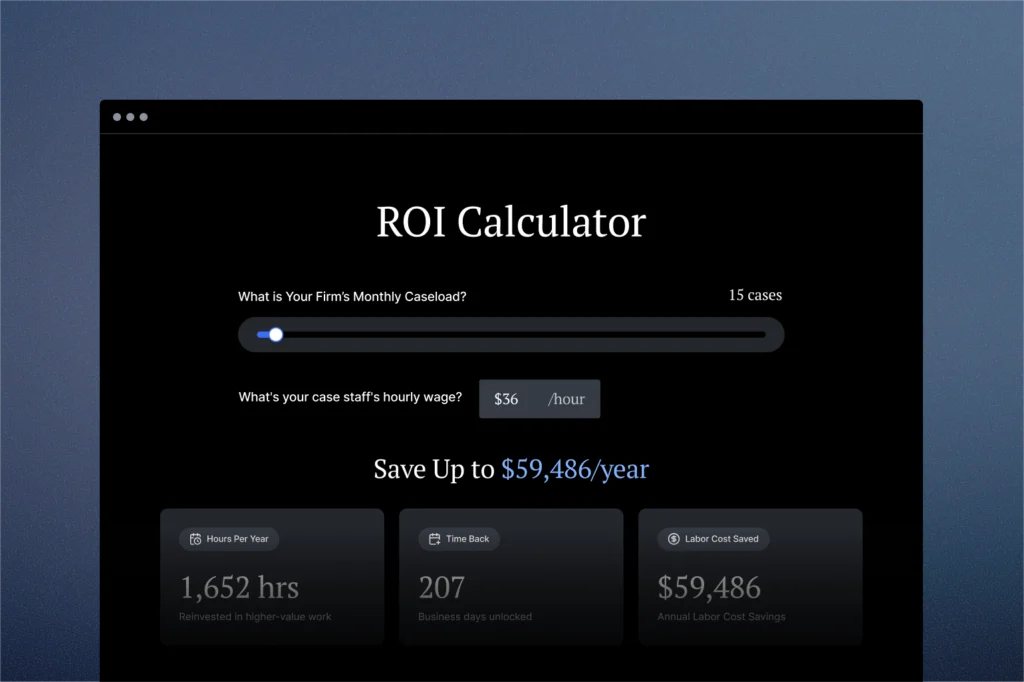
To calculate ROI, compare the time and labor costs of manual document review against the efficiency gains from OCR automation. Measure hours saved per case, reduction in support staff çase work, faster demands, and potential increases in settlement value. Factoring in reduced errors and improved case speed helps determine direct cost savings and revenue impact.