EvenUp Law
July 8, 2025
The rise of generative AI is reshaping every industry—and personal injury law is no exception. But not all AI is created equal.
For firms looking to reduce delays, increase output, and maximize settlement outcomes, the question isn’t just whether to adopt AI—it’s which AI to adopt. So, how accurate is legal AI in practice? The answer depends on the kind of AI you use.
There are two main types of legal AI tools: general-purpose AI and vertical AI, which is purpose-built for a specific industry and even individual tasks within that industry. To make the right investment, it’s essential to understand the accuracy of legal AI tools across these categories and their impact on your firm’s workflows.
Read on to explore how industry-leading personal injury firms use EvenUp’s vertical AI to draft legal documents in minutes across the case lifecycle, maximize case values with precision, and achieve sustainable scale at rapid speed.
Your step-by-step roadmap to launch, adopt, and scale AI across your PI firm.
Download Action Plan
General-purpose AI platforms—like ChatGPT, Claude, or Gemini—are designed to do a little bit of everything. They’re trained on massive datasets and can assist with writing, research, and summarization across various topics.
But by putting “everything” at your fingertips, attorneys and staff may not know where to start with these tools. It’s the “blank canvas” problem—although you can ask ChatGPT anything, you don’t know where to start.
When applying AI in a legal setting—particularly for personal injury—they can quickly fall short. So when you ask “how accurate is legal AI” in regard to output from these general-purpose models? Often, not very accurate.
That’s because general-purpose models:
The result? Time lost double-checking outputs and less efficiency than promised. Worse, they can hallucinate quotes, legal arguments, or case details—putting your firm at risk.
Accuracy is paramount in personal injury case workups. EvenUp’s 2025 benchmarks report found that PI firms are missing an average of five documents and bills for every 10 cases. While one missing document for every other case may not seem like much, each missing bill or supporting document costs up to $3,000 in lost settlement value—depleting case outcomes and costing firms money.
So how accurate is AI when it’s purpose-built for dealing with missing documents and other personal injury needs? EvenUp firms using our Missing Docs Check feature see a 75% reduction in missing documents per case—and missing docs is just one of many modern metrics that EvenUp enables you to track.
See actionable insights that correspond to maximum settlement value—and get industry benchmarks for AI-enabled modern metrics.
Get PI Benchmarks
Tracking and performing well against these modern law firm analytics is critical. Eliminating missing documents, mitigating treatment gaps, expediting demand writing and shrinking overall time between final treatments and demand sends—all these vertical AI-enabled metrics matter. They’re why we see EvenUp firms have a 69% greater likelihood of reaching policy limits on every case.
What is vertical AI—it’s precisely specialized intention, action, and context integrated into an AI model and its outputs. This is how EvenUp’s vertical AI stands apart.
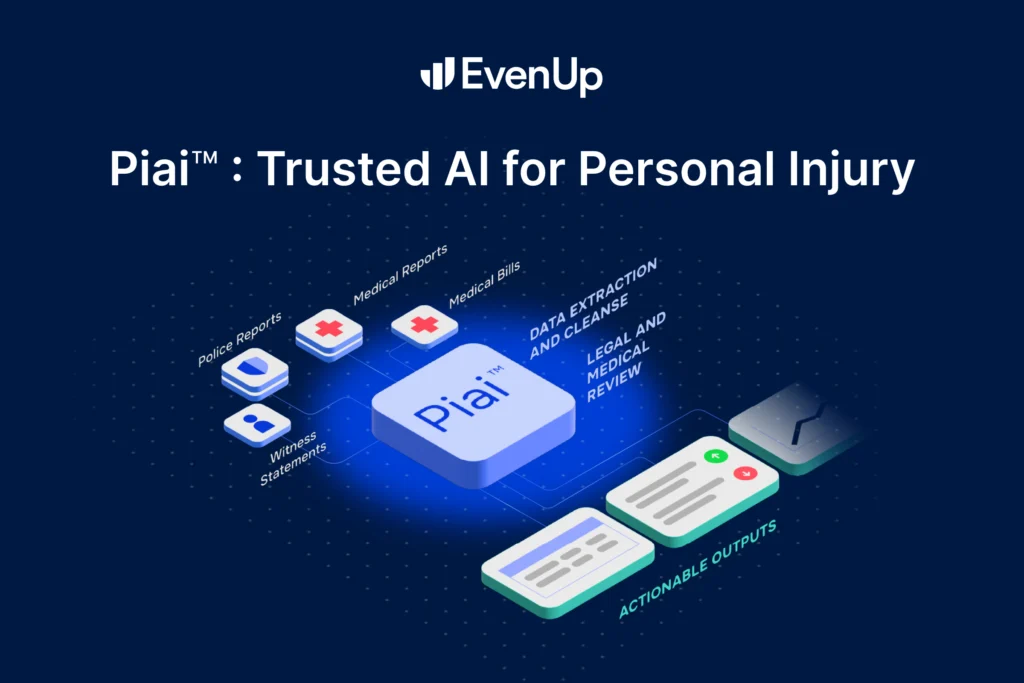
EvenUp’s Claims Intelligence Platform™ isn’t trying to be everything to everyone. It’s built specifically for personal injury and powered by Piai™—the industry’s most advanced system of personal injury AI models, trained on the largest dataset of hundreds of thousands of injury cases and millions of medical records. EvenUp staffs many former attorneys, adjusters, paralegals, medical professionals, and other practitioners who leverage their deep, real-world experience in the space to continually train and optimize the AI and its output.
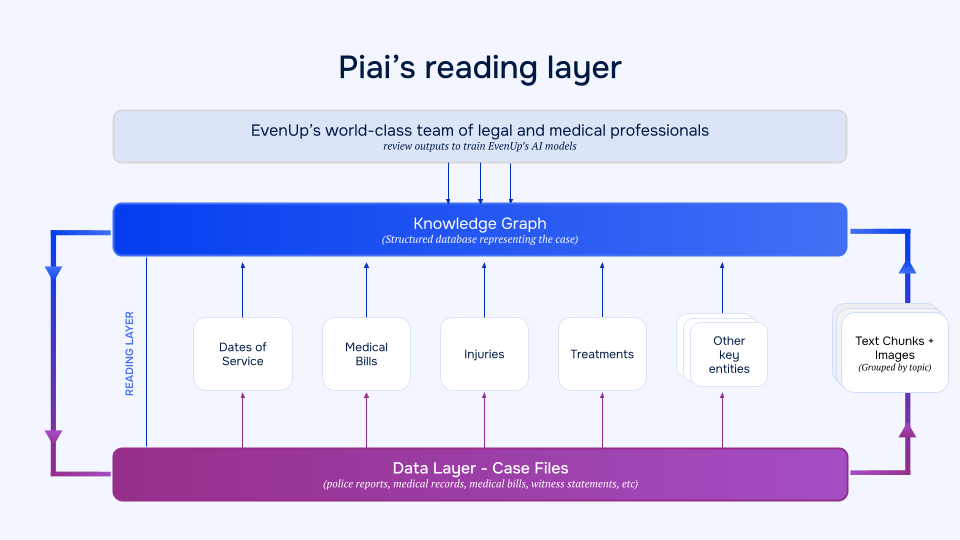
The Reading Layer features the initial processing of unstructured, messy legal documents (like medical records with varied formats, handwriting, circles, checkboxes, faxes, slanted text). The goal of the Reading Layer is to extract structured information for domain-specific purposes in personal injury, including, amongst many others:
EvenUp receives thousands of expert input and data updates daily for each of these “reading layer” models. For example, each day there are thousands of user edits to medical provider names, made both by our end-users (lawyers, paralegals, case managers) and our internal legal experts. Every edit gets fed back into our medical provider model in the “reading layer”, making it better. That’s a powerful, targeted feedback loop that simply doesn’t exist for a general-purpose AI system.
The Writing Layer uses the data extractions from the Reading Layer to generate outputs, such as drafting documents or answering questions. What’s critical here is that the “writing” is highly factual and constrained by the output of the Reading Layer rather than general world knowledge.
With this two-layer approach, Piai™ operates directly on your raw records—not on extracted summaries like other general-purpose AI tools do. That means the EvenUp platform understands how your firm operates—how you intake clients, how you work up a case, and how you manage treatment documentation—as well as how to generate accurate and secure documents and answers to questions.
EvenUp’s generative AI tools, including AI Drafts™, Express Demands™, and Case Companion™, offer a proven way to craft complex legal documents, case summaries, communications, and more in just a few minutes. EvenUp’s verticalized AI tools maximize case outcomes and empower firms to scale confidently with the most trusted AI in personal injury.
Rather than assembling disparate generic AI tools, EvenUp gives your team access to:
AI Drafts™ is EvenUp’s verticalized AI drafting suite that lets you draft high-quality legal documents—from custom motions to negotiation sheets—using a personal injury-focused editor that’s directly integrated with your case files in just a few minutes.
This is not a templating tool. This is AI-powered drafting. It learns your style, your tone, your preferences, and it merges your craft with data. One centralized place with the context of all of your case files, all of your previously drafted documents, all of your firm and individual preferences.
Saam Mashhad
With AI Drafts™, your team can pull in facts, evidence, and templates without leaving their workflow. AI Drafts™ automatically saves all generated documents to your case library for easy access and compliance. This is purpose-built intelligence in action: fast, contextual, accurate, and compliant.
It's nice to be able to face a blank page with an ally where you can type in a rough idea of what you want and start by editing something rather than start from scratch.
Lou Mattar
Read the full William Mattar Law Offices story
Writing demand letters has long been a bottleneck in the case lifecycle. EvenUp’s Express Demands™ eliminates that bottleneck with generative AI trained on tens of thousands of successful personal injury cases. The system pulls from police reports, medical records, and treatment timelines to draft highly persuasive demands in minutes that are consistent, defensible, and often settle faster—sometimes before a letter even gets printed.
Time on desk is something that we all chase. What we see with Express Demands™ is the opportunity to greatly reduce that time on desk and to identify holes and opportunities in things that are missing from our demands.
Dwuan Hammond
Case Companion™ is EvenUp’s legal AI assistant that empowers personal injury attorneys and their support staff to converse directly with case documents in real time. No more scouring over dozens of pages of documents when you can cut straight to the exact insights you need to make better decisions across the duration of a case.
Case Companion is a game-changer. It's like having an AI-powered assistant that does the groundwork for us, giving my team the time and tools to focus more on our clients.
Brett Sachs
Read the full MVP & EvenUp story
For partners and firm leadership, the value of purpose-built AI is clear: greater throughput, lower costs, and higher settlement potential—all without needing to dramatically scale headcount.
For paralegals, case managers, legal assistants, and other support staff, how accurate legal AI is directly impacts their day-to-day: fewer manual tasks, more time for high-value work, less rewrites and second guessing all provide greater trust throughout the case workup.
AI doesn’t replace legal professionals. It supplements and enriches their work—especially when the tools are designed purposefully with their needs in mind.
You wouldn’t trust a general practitioner to perform brain surgery. So why trust general-purpose AI to manage high-stakes legal work—especially ChatGPT-wrapped products masquerading as purpose-built AI?
If your firm is ready to scale with confidence—without sacrificing precision or compliance—it’s time to see the difference a purpose-built solution can make.
Book a demo today and see how EvenUp helps you run your casework like clockwork—with accuracy that’s anything but artificial.
Schedule a call today to see how EvenUp’s AI tools automate repetitive tasks, streamline custom drafting, and empower staff to focus on case strategy and client engagement.
Schedule a Call
Schedule a call today to see how EvenUp's AI tools automate repetitive tasks, streamline custom drafting, and empower staff to focus on case strategy and client engagement.
Schedule a call
Read Now

Read Now

Read Now

Read Now