The best legal document automation software for a personal injury firm is the software built for personal injury. Most legal document automation tools were built for contracts and corporate compliance, and their workflows, data models, and output formats assume a practice area with nothing in common with injury work. For PI, category fit matters more than brand name. When demand delays run past 100 days on a large share of cases, a generic tool does not just underperform. It costs your clients money.
The right legal document automation software eliminates the bottleneck between case intake and demand delivery. It turns case files into complete demand packages by extracting the records, tying every figure to the documented file, and flagging what is missing before the demand goes out. The wrong ones force attorneys to start from scratch, checking every output against records they already reviewed.
Here is how to tell real PI automation from repackaged generic AI.
Legal document automation software uses AI to turn case files into finished legal documents, extracting data from records, structuring it, and drafting the output. For most vendors, that means software built for corporate legal teams, which actively hurts PI firms that try to use it. The assumptions do not transfer. PI firms need tools that understand treatment timelines, ICD codes, and the documentation that determines an injury claim.
That gap is why category matters more than brand name. EvenUp’s Claims Intelligence Platform was built from the ground up for personal injury. It reads medical records, ties the demand to the documented file, and surfaces what is missing, so every document reflects the record rather than a generic template.
Most evaluation checklists miss the criteria that actually matter for PI. Here is what to look for instead.
General-purpose legal AI learns from contracts, corporate filings, and regulatory documents. It has no context for ICD codes, treatment timelines, or how to articulate an injury in a demand. Purpose-built PI AI like Piai is trained on personal injury cases and medical records, so it understands the details adjusters and opposing counsel actually respond to.
The difference between a tool you can trust and one you have to re-check is grounding. The best PI software ties every fact and figure in the demand back to the source document, so a reviewer can verify a charge or a date in seconds instead of flipping through exhibits. It also surfaces the bills and records that are missing entirely, before the demand goes out, when that documentation is still leverage.
Attorneys should not have to rebuild their case management process to adopt new software. Look for tools that connect directly with your existing systems, import records through your current portals, and fit workflows your team already follows. Adoption fails when the tool demands more process change than it delivers in time savings.
PI software handles sensitive medical records, so SOC 2 and HIPAA certifications are non-negotiable. Beyond security, ask vendors for specific, current metrics on data extraction and charge identification, and confirm how the tool grounds its output.
Growing firms need tools that scale with caseload without proportional staff growth. The best software handles surges in intake, drafting, and record processing without degrading quality. EvenUp supports more than 2,000 firms nationwide, from boutique practices to high-volume operations.
The gap between good and bad document AI shows up at ingestion. Generic tools scan documents. PI-specific AI reads them. The system processes case files, medical records, billing statements, and treatment notes, extracts structured data, identifies injuries, maps treatment timelines, and flags missing documentation. The best platforms do this in minutes, not the hours or days it takes a paralegal working by hand.
What separates PI-specific AI from generic models is depth of understanding. Piai™, EvenUp’s proprietary AI, is trained on personal injury cases and medical records, so it captures the providers, dates of service, and charges that a general model drops or misclassifies, the details that directly affect case value.
| Capability | Generic AI | PI-Specific AI (Piai) |
| Training data | General legal corpus, contracts, regulatory filings | Personal injury cases and medical records |
| Charge and record extraction | General-purpose, drops PI-specific detail | Purpose-built for PI records |
| Output grounding | Often none inline | Every figure traced to the source document |
| Missing documentation | Not surfaced | Flagged before the demand goes out |
| Security certifications | Varies by vendor | SOC 2 and HIPAA certified |
| PI case understanding | Treats PI like any other practice area | Purpose-built for the PI case lifecycle |
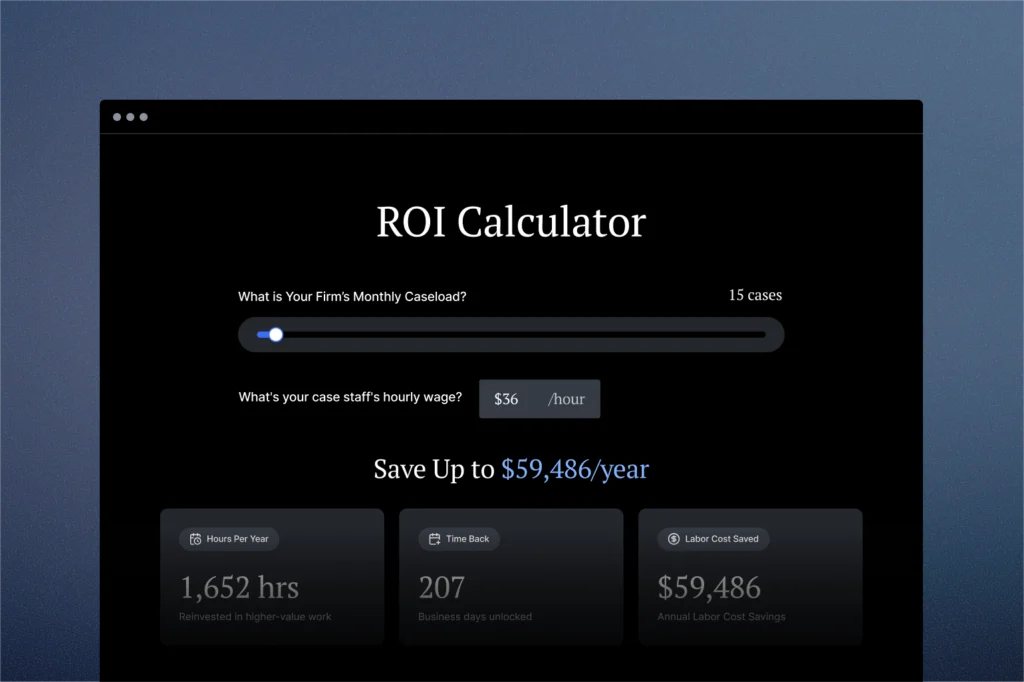
PI firms that still draft demands manually are leaving capacity on the table. AI-powered legal document automation removes the bottleneck without sacrificing quality, so attorneys can focus on strategy and client relationships and the firm handles higher caseloads per attorney without adding headcount.
Manual drafting is time-intensive and uneven across a team. EvenUp firms send demands substantially faster than the manual baseline, which translates directly to faster resolutions. The mechanics of building a strong demand are covered in the guide on how to write a personal injury demand letter.
In personal injury, a missed charge or an undocumented figure gets discounted by the adjuster. EvenUp catches the missed charges and surfaces the treatment gaps and missing records that manual review overlooks, so the demand reflects the full documented record. Firms using EvenUp Demands see a 69% higher likelihood of policy limit settlements. The demand amount is always the firm’s decision; the software makes sure the draft is grounded in the complete file.
Small and mid-sized firms often struggle with growing caseloads. Automation lets a firm scale operations without sacrificing quality. EvenUp supports more than 2,000 firms nationwide, from boutique practices to high-volume operations.
Firms running purpose-built PI AI reallocate hours from document creation to negotiation, litigation prep, and client communication. That operational leverage compounds as the practice grows, and it points toward a fundamentally different growth model for PI firms.
What matters is not any single tool but whether the platform covers the full PI case lifecycle, from intake through litigation.
AI Drafts is EvenUp’s drafting suite for personal injury firms. It generates demands, complaints, medical summaries, deposition summaries, interrogatories, negotiation sheets, mediation briefs, plaintiff emails, and court-ready exhibits from selected case files, ready in minutes rather than hours.
The differentiator is Mirror Mode. Upload your firm’s best example documents, and AI Drafts replicates your format, language, and structure as reusable templates across the team, so every draft matches your standards. The highest-leverage version of this is capturing the best practices of your best people as reusable firm standards. AI Drafts is built for review, not rewrites.
Demand packages are the cornerstone of a PI claim. EvenUp’s Express Demands generate a structured demand fast, integrating records, expenses, and case narrative into a cohesive document grounded in the file. For firms weighing a general tool against a purpose-built one, the guide on how to choose an AI legal writer for PI cases walks through the decision in detail.
Preparing medical chronologies is one of the most labor-intensive parts of PI work. EvenUp’s MedChrons™ synthesize complex medical data into clear chronological summaries that adjusters and opposing counsel can follow, saving time and strengthening the record.
Proactive Workflows, powered by AI Playbooks, automate the decision layer around your cases. The system analyzes case files on upload, surfaces critical insights, and triggers the right task at each stage. After a one-time setup it runs on autopilot, identifying high-value cases and flagging missing records so nothing falls through the cracks as your caseload grows.
Most “best legal AI” lists rank tools by feature count. For personal injury, that metric is meaningless. Generic legal AI can handle basic document assembly, but it lacks the training, the medical understanding, and the record-grounding that PI documents require.
Evaluate any platform against the criteria that actually matter for personal injury:
For a personal injury firm, the best legal document automation software is the one that answers yes to all four. Schedule a call to see the difference on your own cases.