Treatment gaps in personal injury settlements are an unexplained break in a client’s medical care. These gaps in treatment commonly cause losses in personal injury case value.
Insurance adjusters read gaps as evidence that the plaintiff was not really hurt, was hurt and recovered, or is exaggerating. Whatever the truth, a gap hands the carrier a discount argument that the firm then has to negotiate against. The expensive part is when the gap is discovered, because most firms find out at demand drafting, months after the gap formed, and long past the point at which anything could be done about it.
Thirty-day breaks in care are typically considered treatment gaps in personal injury settlements. However, any unexplained break that’s long enough for an adjuster to argue discontinuity can count as a gap.
Three patterns show up most with treatment gaps in personal injury cases:
The distinction that matters: a documented, explained break (provider scheduling, a planned surgical wait, a documented plateau) is a footnote. An unexplained break is a liability. The difference between the two is usually whether anyone at the firm noticed in time to get the explanation into the record.
As leverage on causation, severity, and credibility, the three pillars a settlement number rests on.
| Causation | A gap breaks the clean line between incident and injury; anything after the gap can be attributed to something else. |
| Severity | Sparse treatment reads as a minor injury regardless of the diagnosis, because carriers price the record, not the injury. |
| Credibility | Inconsistent treatment invites the argument that the plaintiff’s account cannot be trusted, which discounts everything else in the file. |
The compounding problem: gaps are permanent.
Once a 30-plus-day gap exists in the treatment record, no demand letter language can fill it. The negotiation starts with a discounted anchor, and the firm uses leverage to explain the past rather than press value.
More common than most firms believe, and they accumulate with case age.
EvenUp’s case analysis shows 17% of cases develop a 30-day treatment gap within the first three months of treatment, rising to 32% by month six.
Read that against a working caseload: a case manager carrying 60 cases is statistically sitting on roughly 20 forming or formed gaps at any given time. The question is not whether your firm has treatment gaps. It is how many exist right now that nobody has seen.
Because most firms monitor treatment passively, gaps remain silent as they form.
A missed appointment generates no alert. A client who stops going to physical therapy does not call the firm to report it. The treatment record only reveals the gap when someone assembles it end-to-end, and in a passively monitored caseload, that assembly happens once: during demand preparation. By then, the youngest gaps are months old.
This is a systems failure, not a staff failure. Expecting a case manager to manually track appointment adherence across dozens of cases and hundreds of monthly appointments inevitably leads to missed appointments. The firms that catch gaps early have made adherence visible: appointment-level tracking, automated client check-ins after scheduled visits, and provider follow-up that surfaces no-shows within days instead of months.
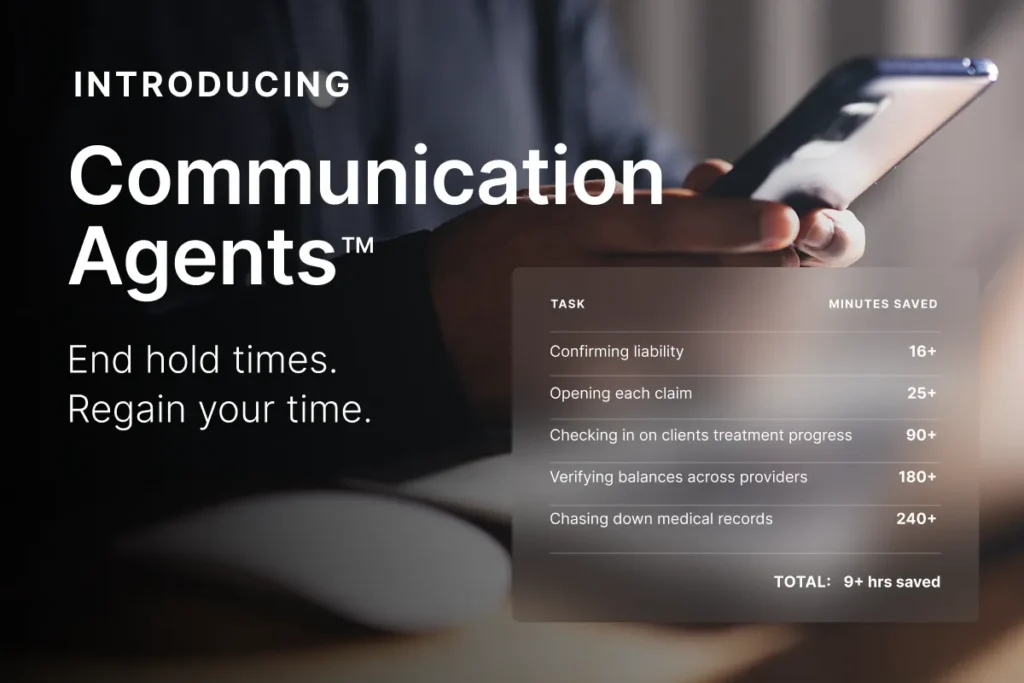
EvenUp’s Communication Agents™ have made this economical at the caseload scale; the follow-up call a case manager could never consistently make across 60 cases is exactly the work an automated agent does uniformly.
Caught inside a week, a gap is a phone call: the client reschedules, or the reason gets documented, and the record stays clean. Caught at demand, it is a permanent discount.
Proactive, purpose-built personal injury AI attacks the treatment-gap problem at its root cause, enabling firms to see a gap while it is still fixable. General case management systems aren’t built to do this. And manual tracking can’t do this on the caseload scale. EvenUp and our Medical Management™ are built for exactly this. The advantages show up in four specific places.
The strategic framing for firm owners: treatment-gap tooling is not an efficiency purchase; it is a case-value purchase. It is evaluated against settlement dollars and preventable gap costs, not against the software line in the budget. A single gap closed early on a serious case can be worth more than a year of the tooling that caught it.
Sometimes, but explanation is mitigation, not repair.
Legitimate explanations exist: the client lost transportation, childcare fell through, a provider’s schedule slipped, or symptoms genuinely improved before worsening again. If those reasons enter the record contemporaneously (a documented call, a provider note), the gap has context and loses most of its force. Reconstructed months later, the same explanation reads as advocacy. Adjusters discount post-hoc explanations for the obvious reason.
The operational rule that follows: the value of gap detection decays by the week. A firm that surfaces missed appointments within days preserves the ability to document reasons while they are fresh, which is worth more than any amount of skilled demand writing after the fact.
Treatment gaps are a settlement problem that masquerades as a client behavior problem. Clients will always miss appointments; the variable a firm controls is whether anyone notices in time to act. Firms that monitor treatment passively find gaps at demand time, when they are permanent and priced in. Firms that instrument adherence find them in the first week, when they are a phone call. Across a full caseload, that difference compounds into one of the largest controllable swings in average settlement value a plaintiff firm has.