Most intake tools optimize conversion. They answer the question, “Did we sign this lead?” That is not the same question as “will this file hold its value?” Optimal personal injury intake processes capture critical facts at sign-up that determine what the case is worth eighteen months later, and most firms are not built to do it.
Most personal injury firms lose winnable cases before an attorney ever reviews the file. The intake process is where that failure starts.
Intake optimization is usually sold as a conversion problem. Faster speed to lead, better chase sequences, and higher signed-agreement rates. Those things matter, and a firm that signs nothing has no cases to optimize. But conversion is the easy half. The harder half is whether the file your intake team builds on day one can still support a full-value demand a year and a half later, after treatment has matured, after the client has changed jobs, and after the adjuster has decided what story the record tells.
That is a documentation problem, not a conversion problem. This guide covers what to capture, who should own it, where AI genuinely helps, and where it does not.
The personal injury intake process begins before any medical treatment occurs. The goal is to quickly assess the incident, injury severity, liability, and available insurance coverage. That determines whether a case is worth pursuing and how to allocate resources against it.
The pre-sign stage is where most firms already have tooling and measure themselves. It is also the stage that matters least to eventual case value, because everything decided here is reversible and everything captured here is thin.
Eight categories. The more complete the capture, the better positioned the firm is to evaluate the case, track treatment, and accelerate workup.
Full legal name, date of birth, and Social Security number. Driver’s license number and state of issue. Current and previous addresses. Preferred method and time of contact. Emergency contact details.
A note that most intake guides skip: the moment a firm collects SSNs and dates of birth, it has taken on a data-security obligation, and that obligation extends to every vendor and system the data touches. Confirm how this information is stored and who can reach it before you standardize the collection, not after.
Date, time, and location of the accident. Weather and lighting conditions. Road or environmental hazards. A detailed client description of what happened. Whether police were called and a report filed. Any photos or videos from the scene.
Structured forms outperform open-ended notes here. Prompt explicitly for pain points (“Where did you feel the impact?”), secondary collisions, and statements the defendant made at the scene.
Immediate symptoms and diagnosed injuries. First point of medical contact. Treatment received at the scene and in the days following. Current treatment plan and scheduled appointments. Pre-existing conditions that may complicate the claim. Names and contact information for treating providers.
Injuries drive case value, and this is the category most often captured badly. The client is in pain, medicated, or in shock, and will underreport. Ask twice, and ask again at the first follow-up.
Names and contact details for anyone who saw or heard the accident. Notes on their perspective and anything they said at the scene. Whether third parties took photos or video. Security camera availability nearby.
Witnesses decide contested liability, and their availability decays fast. This is the most time-sensitive category on the list.
Auto and health insurance carriers. Policy numbers and group IDs. Known policy limits, including BI, UM/UIM, and PIP. The defendant’s insurance information. Any letters already received from insurers. Whether claims have been filed or offers extended.
Prior personal injury lawsuits or insurance claims. Bankruptcy filings within the past seven years. Current or prior representation by another attorney. Signed agreements with prior firms, and any potential liens.
Current employment status, job title, and length of employment. Lost wages, past and projected. Use of sick leave, vacation, or disability benefits. Out-of-pocket medical expenses. Transportation, household help, or home modifications. Receipts and pay stubs that support all of it.
Signed retainer or client agreement. HIPAA and medical record authorizations. Permission to contact employers and providers. Acknowledgment of responsibilities and risks.
Firms should also be aware of ABA Model Rule 5.3, which sets supervision requirements when nonlawyer staff handle intake tasks. Introducing AI into intake does not change who is responsible for the work product, and the supervision obligation applies to the tool the same way it applies to a paralegal. Any firm adopting AI at intake should be able to name, in writing, who reviews what and when.
| Category | Key Items | Why It Matters | Common Mistakes |
| Client Identification | Full name, DOB, SSN, contact preferences | Establishes identity and communication channels | Missing preferred contact method, outdated addresses, no data-handling policy for the SSN you just collected |
| Incident Details | Date, location, conditions, police report, photos | Anchors liability analysis and timeline | Vague descriptions, no follow-up on scene evidence, never asking what the defendant said |
| Injury and Medical Info | Symptoms, providers, treatment plan, pre-existing conditions | Drives case valuation and treatment tracking | Failing to document pre-existing conditions, accepting the client’s first symptom report as complete |
| Witness Information | Names, contact info, perspective notes, camera footage | Strengthens liability position | Not asking about security cameras or bystander video, waiting a week to call |
| Insurance Information | Policy numbers, limits (BI, UM/UIM, PIP), defendant coverage | Determines recoverable damages | Incomplete policy limit data, missing defendant info, never checking for umbrella coverage |
| Client Legal History | Prior claims, bankruptcies, prior attorneys, liens | Reveals conflicts and strategic risks | Skipping bankruptcy and lien screening |
| Employment and Financial | Lost wages, out-of-pocket costs, receipts, pay stubs | Quantifies economic damages for demand | Not requesting supporting documentation upfront, capturing job title but not earning trajectory |
| Authorization and Compliance | Retainer, HIPAA forms, employer/provider consent | Legal basis to proceed and gather records | Delays in obtaining signed authorizations |
The right-hand column is the useful one. Every firm knows what to collect. The gap between firms is in what they forget to collect, and those failures are consistent enough to be designed against.
Once the agreement is signed, intake moves into the work that actually determines case value.
This is where Case Companion™ does real work: retrieving key facts across raw records, summarizing documents, and producing narratives with line-level citations back to the source page. The citation discipline is the point. An unsourced AI summary is a liability at intake, not an asset.
| Firm Size | Typical Intake Staff | Common Bottleneck | Where AI Helps |
| Small (1 to 5 attorneys) | Paralegal or attorney handles all intake | Multitasking overload, missed follow-ups | Automating file review and case prioritization so one person can carry more cases |
| Medium (6 to 25 attorneys) | Split between case managers and paralegals | Information lost in handoffs between roles | Structured summaries that travel with the file, so every role sees the same verified data |
| Large (25+ attorneys) | Specialized intake, operations, and admin departments | Syncing tasks across departments and offices | Standardized data capture across offices, plus pipeline visibility for leadership |
The bottleneck varies by size, so the same tool yields very different returns depending on who is using it. A solo practice buying AI to solve a handoff problem it does not have will be disappointed.
Common Intake Challenges
Missed red flags and bad signups. Soft-tissue-only injuries against low policy limits, questionable liability narratives, and prior claim histories that complicate strategy tend to surface late, after the firm has already invested attorney time. AI Playbooks™ can flag these against firm criteria as documents arrive, including proactively surfacing TBI, commercial defendant, and DUI indicators.
Incomplete documentation. Incomplete files are among the most common reasons cases stall in pre-litigation. The fix is systematic gap detection at the point of intake and tracking requests until the file is complete, rather than a paralegal noticing something is missing three months in.
Poor medical treatment tracking. Treatment gaps weaken claims, and they are invisible without a living timeline. Medical Chronologies turn scattered records into a dated timeline that updates as new records arrive, making gaps visible while they can still be addressed.
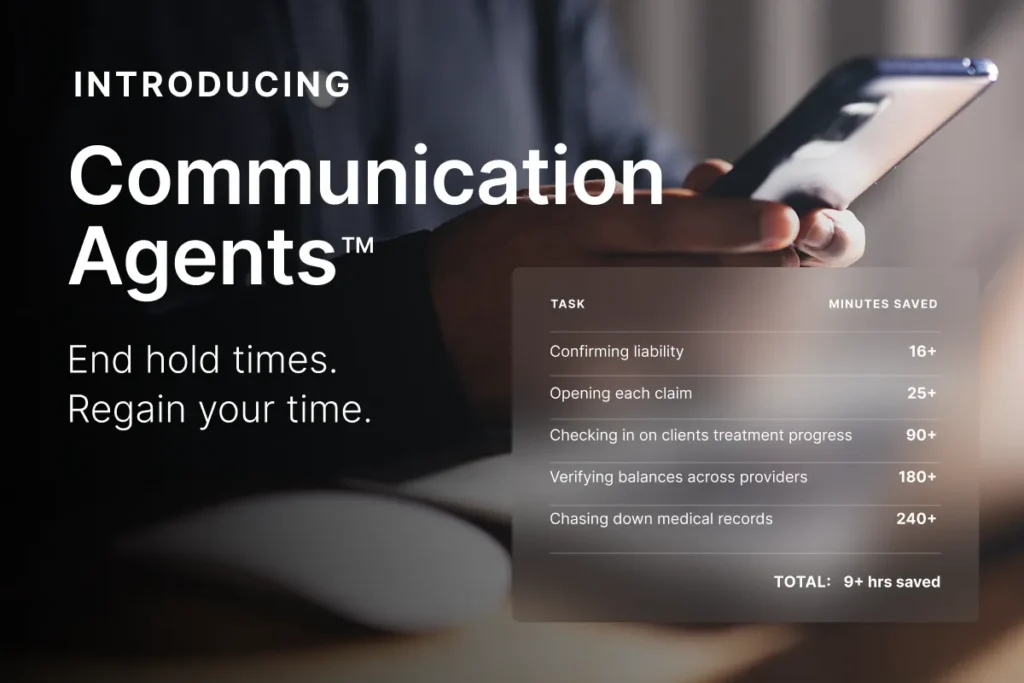
Slow follow-up and communication gaps. The firm that makes meaningful contact first usually wins the engagement, and clients who go quiet after signing are the ones whose delayed symptoms never make it into the record. Communication Agents™ automate outreach, reminders, and status updates, and log every touchpoint back to the file.
EvenUp is not an intake platform, and firms evaluating intake tools should understand the difference before they buy anything.
Intake software solves the front door: lead capture, chase sequences, e-signature, and conversion tracking. Case management systems store the file. Those categories are real, they are mature, and EvenUp does not compete in them. EvenUp integrates with the case management systems firms already run.
What EvenUp does is different. Our purpose-built, proactive AI platform works across the case lifecycle, from intake through resolution. Its job at the intake stage is not to sign the lead but to read what intake captured, find what intake missed, score the case against firm criteria, and carry structured facts forward into treatment tracking, demand drafting, and negotiation.
The practical implication for a firm: an intake tool and a lifecycle platform are not substitutes, and a firm that buys one expecting the other will be unhappy. Intake software that converts leads brilliantly will still hand you a thin file. A lifecycle platform will not fix your speed-to-lead.
Here are five criteria to consider when evaluating AI for intake processes:
1. Personal injury specialization. PI cases involve injury severity scales, treatment protocols, and stacked policies that general-purpose legal AI is not built to assess. Ask what the model was trained on and whether the vendor can describe how PI-specific reasoning differs from generic document summarization.
2. CMS integration depth. The tool has to work inside the case management system the firm already runs, not alongside it. Shallow integrations requiring manual export defeat the purpose. Ask which systems are supported natively and what “supported” means in practice.
3. Data security and supervision. Intake involves protected health information from the first client contact. Ask vendors for documentation of their security posture rather than accepting marketing claims, and ask specifically how case materials are protected in transit and at rest, and whether reasoning is confined to a single matter or crosses cases and firms. Then ask the harder question, which most firms skip: under ABA Model Rule 5.3, who at your firm supervises the output, and how do they verify it?
4. Scalability across firm sizes. The platform should adapt to a three-attorney practice and a two-hundred-attorney firm without forcing either into the other’s workflow.
5. Downstream connectivity. Intake data should not sit in a silo. Ask whether intake capture flows into treatment tracking, demand drafting, and negotiation, or whether the firm will re-enter the same facts three times.
Personal injury intake optimization is not a conversion exercise. It is the first and cheapest opportunity to build a file that can hold its value under eighteen months of defense pressure.
Firms that get this right identify high-value cases within minutes of file receipt, catch risk factors before attorney hours are spent, close documentation gaps before they stall pre-litigation, and connect every intake data point to downstream case value. None of that happens because a tool was purchased. It happens because the process was designed first, and the tool was chosen to fit it.
Schedule a call to see how EvenUp’s proactive AI operating system works from intake to resolution.