The right pre-litigation case management strategy catches common value leaks while they can still be fixed. Most personal injury firms over-focus on demand drafting when case value is usually won or lost during treatment. By the time drafting starts, the adjuster already owns the story of inconsistent care, weak causation, incomplete specials, and unanswered bad facts.
Because by the time you open the demand template, the record is already written.
Most firms treat their pre-litigation case management as the waiting period between signing and negotiating. It is not. It is the only window in which the facts of the case are still being created. Treatment is ongoing, symptoms are still emerging, records are still being generated, and the client is still available to explain a missed appointment. Every one of those things hardens into the record, and the record is what the adjuster evaluates.
The contrarian version, which is uncomfortable but correct: most PI firms over-focus on demand drafting when case value is usually won or lost during treatment. A faster demand built on a fractured file is a faster way to arrive at a lower number. By the time the drafting starts, the adjuster already has the story of inconsistent care, weak causation, incomplete specials, and unanswered bad facts.
Cases rarely collapse on one miss. They leak value through small, preventable failures over 90 to 180 days.
Treat them as negotiation problems first and medical problems second.
When staff learn about missed appointments and referral failures after the damage is done, the adjuster already owns the narrative of inconsistent care. The fix is real-time monitoring against defined thresholds, not a periodic file audit that catches the gap a month late.
| Signal | Threshold | Action |
| Missed appointment | Same day | Automated client outreach |
| No visit logged, still in active care | 14 days | Flag to case manager exception queue |
| Unresolved gap | 21 days | Escalate to supervising attorney |
| Discharge without follow-up scheduled | Immediate | Attorney review before file advances |
| Plan of care not completed | At discharge | Document the reason in the file, always |
That last row is the one firms skip, and it is the cheapest point of recovery in the entire workflow. A client who misses three weeks of chiropractic care because of a transportation problem has a documented reason. A client whose file says nothing has an adjuster’s argument that the injury was not serious. Same facts, different record.
Case managers should work the exception queue daily rather than manually auditing every file. The point of automation here is not speed. It is that exceptions surface while they are still fixable.
By scanning records for the language that appears before anyone realizes the case has changed.
Higher-value facts emerge gradually. A PCP note may mention dizziness, headaches, radicular pain, or a neurology referral weeks before anyone recognizes what the file is becoming. Playbooks should scan records and notes for missed specialty referrals, TBI or concussion language, escalating symptom clusters, MMI references, and inconsistent pain or mechanism reporting.
The goal is not to let AI make legal judgments. The goal is to give attorneys time to intervene while the medical story can still be clarified, documented, and preserved. This matters most in mild TBI, where a normal CT scan at the ER routinely gets read as the absence of injury and the file is quietly downgraded to soft tissue. For the full workflow on that, see our guide on maximizing TBI case value at intake.
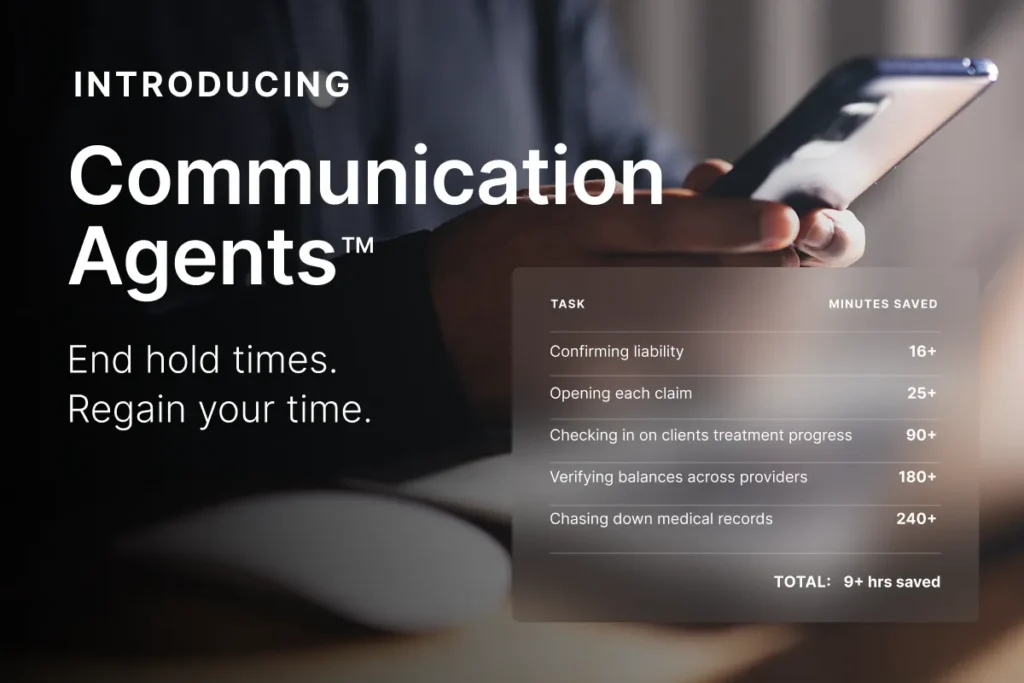
Pair detection with automated client communication for appointment reminders, treatment check-ins, and status requests. Keep legal advice, medical guidance, and settlement discussions with licensed staff. Set guardrails: approved templates only, human review for escalations, and an audit trail on every outbound message.
On timers, statuses, and escalation rules. Not on personal persistence.
Incomplete records create incomplete demands, and the failure mode is almost always the same. A chiro note references urgent care. An MRI report references orthopedics. The provider never gets added to the list, and the records never get requested. Nobody notices until the demand is being assembled and the chronology has a hole in it.
AI is well suited to flagging referenced providers and missing documents across bills, notes, and records, so records staff own a follow-up queue and attorneys see only the exceptions that affect readiness or narrative risk. Build the workflow to send the request, track the receipt date, prompt follow-up automatically on a 15-day cycle, and escalate after 30 days of provider silence or whenever the deadline threatens demand readiness.
Bill reconciliation belongs in the same live workflow, not at the end of it. Keep a provider-by-provider ledger with bills received, balances confirmed, and missing charges flagged. If reconciliation starts at the demand stage, the team is already late, and the specials in the demand will be the number you could prove rather than the number you incurred.
A self-updating medical chronology is what makes this legible. It is not a convenience feature. It is a supervision tool that lets an attorney see what happened, what is missing, and what changed without reading the entire file from scratch. Medical Chronologies build that timeline as records arrive rather than as a one-time exercise before the demand.
By writing down what your best case manager notices, and making the system notice it on every file.
Top firms do not rely on one person catching everything. They codify judgment into rules that flag liability weaknesses, adverse facts, care gaps, missing documents, and readiness blockers by case type. That creates consistency across the docket and reduces variance between teams, which is the difference between a firm with good cases and a firm with a good process.
Case-level assistants add leverage when they answer narrow, auditable questions fast: Is treatment still active? Which providers are missing records? What is blocking demand readiness? Use Companion to accelerate supervision, not replace it. Messy source data still yields messy answers, and no assistant will surface a fact the file never captured.
The governing rule, worth putting on a wall: AI can draft and check, but it cannot send.
A static system stores notes and PDFs. A platform of action launches tasks, recommends next steps, updates timelines, and escalates exceptions based on matter data and documents. Pre-litigation depends on execution, not storage, and most firms have bought storage.
Build standard matter plans for each case type with named owners:
Sync calendars, communications, records vendors, billing data, and documents so the file updates without duplicate entry. Then track a short dashboard rather than a long one: days to treatment completion, missing records by file, bill reconciliation status, time to attorney review, demand readiness rate, and lifecycle length by case type.
If those numbers are not visible weekly, accountability arrives too late to change anything.
Four phases over 16 weeks. Do not try to automate everything at once.
| Phase | Weeks | Scope |
| 1 | 1 to 4 | Treatment-gap monitoring and client reminders |
| 2 | 5 to 8 | Records retrieval and bill reconciliation |
| 3 | 9 to 12 | Readiness dashboards and case-type matter plans |
| 4 | 13 to 16 | Case-level AI assistants for supervisors and attorneys |
Every pre-litigation case management automation needs an owner, an SLA, and an escalation path. If no one owns the exception queue, the workflow is theater.
Plan honestly for what will go wrong. False positives will annoy your staff in the first month. Poor data hygiene in the existing system will produce bad flags until it is cleaned. Staff will resist rules that feel like surveillance, and they are not entirely wrong to. Integration gaps will surface in week three, not week one. None of these are reasons not to do it. All of them are reasons not to do it all at once.
Measure whether the rollout shortens lifecycle, reduces manual review time, increases demand readiness rate, and lifts settlement value by case type. Do not buy on demos alone.
Then the honest answer is that a better system will not save you, because the system still needs people to work it.
Everything above describes work: someone clears the exception queue daily, someone chases the nonresponsive provider on day 30, someone reconciles the ledger. Automation reduces that labor. It does not eliminate it. A firm that is already underwater on pre-lit headcount will buy the software, fail to work the queues, and conclude that the software did not work.
That is the gap PLAAS exists to fill. Pre-Litigation as a Service combines PI-specific AI with EvenUp’s US-based case management team to run the full pre-litigation lifecycle, from claim setup and investigation through care coordination, records retrieval, demand preparation, and settlement negotiation. It is not a tool layered on top of the existing workflow. It is an integrated extension of the firm’s pre-litigation team.
Publicly reported PLAAS results: firms recover 95% of available third-party policy limits, request medical records 66 days faster, deliver demands 47 days faster, reduce time on desk by up to three months, and save approximately $1,000 per case in carrying costs.
Build it or buy it. The one option that does not work is deciding pre-litigation is a waiting period.
When treatment is monitored, records are complete, bills are reconciled, and bad facts are surfaced early, the demand reads like the natural conclusion of a well-managed file rather than a rescue mission.
If the team spots the weakness before the adjuster does, options still exist: close the record gaps, address the referral failures, clarify the chronology, and frame damages with more credibility. Once the demand is served, those options are gone. That is why repeatable pre-litigation protects case value at scale rather than only on the star files.
The firms that win the next phase of personal injury will not be the firms that draft demands fastest. They will be the firms that manage treatment, records, bills, and risk better from day one.
What is pre-litigation case management for personal injury cases? Pre-litigation covers every operational step between signing the client and filing suit: claim setup, liability investigation, treatment monitoring, medical records retrieval, bill reconciliation, and demand preparation. It is typically the longest phase of a personal injury case and holds the greatest concentration of repetitive, high-volume work.
Why do treatment gaps reduce settlement value? Because an unexplained gap in care lets the adjuster argue the client recovered or was never seriously injured. The gap itself is often benign, such as a transportation problem or a scheduling conflict. What damages the case is that the reason was never documented. A gap with a recorded explanation is a fact. A gap without one is the defense’s argument.
When should a firm request medical records? Once a treatment pattern is established, not at maximum medical improvement. Waiting until MMI creates dead time that slows the demand and hurts cash flow. Requests should run on a 15-day follow-up cycle with escalation after 30 days of provider silence.
Can AI make case decisions in pre-litigation? No, and it should not be configured to. AI is well suited to monitoring, flagging, routing, and quality-checking. Legal judgment, causation framing, settlement position, and the decision to send anything remain with licensed staff. The working rule is that AI can draft and check, but it cannot send.
Should a personal injury firm outsource pre-litigation? It depends on whether the firm has the staff to work the process it builds. Automation reduces pre-litigation labor but does not eliminate it. A firm that is already understaffed will buy workflow software, fail to work the exception queues, and get no benefit from it. Outsourcing models like Pre-Litigation as a Service exist for firms in that position, where the constraint is capacity rather than tooling.