In a traumatic brain injury case, severity, liability, and policy limits set the ceiling, and none of them are in the firm’s control. What the firm controls is how much of that ceiling the record can reach. Firms that maximize TBI value force symptom capture at intake, run a structured 30-day follow-up sequence, and build a time-stamped causation timeline. The value is created in the first 30 days, not at demand.
At intake, in the first 30 days, before anyone knows the case is a TBI case.
Every firm knows the ceiling on a brain injury case is set by factors outside its control. Severity. Liability facts. Jurisdiction. Policy limits. Firms compete on none of that, and no intake process changes it.
What a firm controls is the distance between what a case is worth and what the file can prove. That gap is where TBI value is won. It opens in the first 48 hours, when an emergency department produces a chart built to rule out fractures, bleeding, and swelling, and a firm reads that chart as though it were built to document a brain injury. It closes when a firm builds its own record instead of inheriting someone else’s.
The intake script, not the radiologist, determines how much of the ceiling the case reaches.
Yes. A normal CT scan is one of the most common features of a valid mild TBI claim, not a reason to doubt one. Firms that understand this preserve cases that firms reading the chart at face value write down to soft tissue.
The National Institute of Neurological Disorders and Stroke defines a traumatic brain injury as a brain injury caused by an outside force, including a forceful bump, blow, or jolt to the head or body. Two things in that definition create value at intake. First, a direct head strike is not required. A body jolt severe enough to snap the head forward can produce injury with no impact to the skull, which means mechanism screening catches cases that head-strike screening misses. Second, NINDS notes that clinically validated imaging, blood tests, and other measures do not always detect mild or concussive injury, while MRI and neuropsychological testing may reveal deficits later.
NINDS also recognizes that secondary injury can develop over hours, days, or weeks after trauma. The practical consequence is favorable: the best proof in a mild TBI case is usually still ahead of you at intake. It is available to any firm with a system to collect it.
| What the ER Record Gives You | What Maximizing the Claim Requires |
| Rules out bleeding, fracture, swelling | Mechanism consistent with brain injury |
| Point-in-time symptom snapshot | Symptom progression documented over 30 days |
| Discharge status | Functional loss of enjoyment; at work, at home, and in relationships |
| Imaging that may not detect mild injury | Later clinical findings and neuropsychological testing |
| No witness observations | Third-party accounts of behavior change |
The right column is entirely within the firm’s control. That is the whole opportunity.
Mild TBI symptoms are commonly delayed, subtle, or masked by orthopedic pain, medication, shock, or emotional distress. A client can look entirely functional at discharge and develop headaches, dizziness, sleep disruption, memory problems, and irritability within days. Capturing those symptoms as they emerge is the highest-leverage thing an intake process does.
The obstacle is language. Clients rarely say “I have a TBI.” They say “I feel off,” or “I keep forgetting things,” or “I am sleeping all day.” An open-ended question surfaces none of that. A forced-response script surfaces all of it. Require explicit yes or no answers on:
Consider an illustrative auto case. The ER CT is normal and neck pain dominates the first visit. By day three, the client reports repeating questions, light sensitivity, and a memory gap after impact. The spouse confirms unusual irritability and 12-hour sleep stretches. The mechanism, the symptoms, and the corroboration were all available. Only a system captures them at the moment they appear, while they are still contemporaneous and therefore credible.
As a prompt and routing layer. Not as a medical or legal decision maker.
That constraint is what makes the workflow defensible, and it is worth stating before any firm builds it. AI triggers tasks, scores risk, and preserves facts. It does not give medical advice, and it does not reach legal conclusions. A firm that respects that line can automate aggressively. A firm that crosses it has a different problem than case value.
In practice, a structured intake form pairs with a rules layer that forces completion of required fields, scores symptom patterns, and routes flagged files to same-day human review. Minimum inputs: mechanism of injury, head strike or body jolt, loss or alteration of consciousness, pre- and post-impact memory, current symptoms, onset timing, ER imaging, discharge instructions, and witness names.
For every crash, fall, struck-by, or violent jolt, the script asks whether the head hit anything, whether the body snapped forward or sideways, what the client remembers before and after the event, whether anyone observed confusion or repetition, and when symptoms began. That is how a firm catches the case where the mechanism is strong but the client never connected the symptoms to a brain injury.
After a normal CT, any two neuro symptoms, any memory gap, or any witness-observed behavior change should auto-generate three tasks: attorney review within the day, witness outreach within 24 hours, and a documented prompt for medical follow-up.
Five touches across 30 days, using the same checklist every time.
One intake call cannot capture a mild TBI, because the symptoms that establish the claim have not appeared yet. Structured check-ins at 24 hours, 72 hours, 7 days, 14 days, and 30 days catch them as they emerge. Automate the outreach and create a staff call task on any non-response.
Reusing the same short symptom checklist at every touch is what converts scattered complaints into an asset. Answers become comparable across time rather than collected in isolation. New headache plus light sensitivity, or worsening fatigue plus concentration trouble, raises the risk score and reopens review.
That trend line is the single most valuable document in a mild TBI file. A defense expert can dismiss one report of dizziness. A defense expert has a much harder time dismissing the same complaint escalating across five time-stamped touchpoints, each one recorded before anyone knew it mattered.
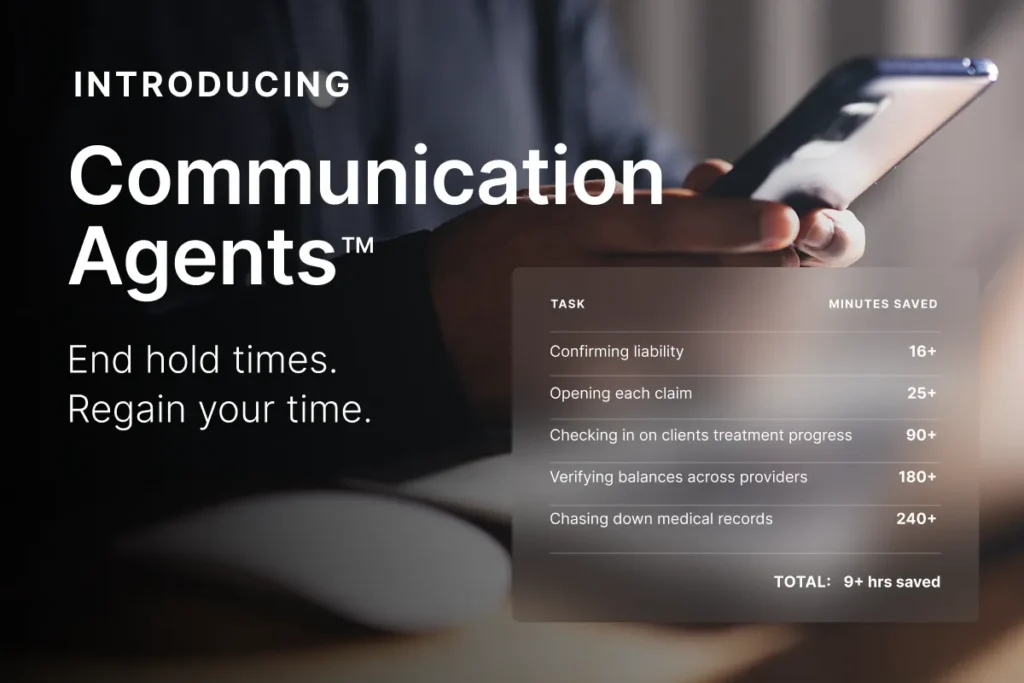
This is the layer most firms leave to memory and good intentions, which is exactly why it is available as an advantage. Communications Agents™ run the outreach cadence, capture responses into the file, and escalate on pattern rather than on whoever remembers to call. This is a scalable approach to reaching maximum medical improvement on TBI cases.
Directly, and more than most firms account for.
Published settlement ranges for traumatic brain injury are close to useless as a planning tool. They span from modest soft-tissue-adjacent outcomes to catastrophic-injury verdicts, and the spread is driven by severity, jurisdiction, policy limits, and liability facts that no firm controls. An average built across that spread describes nothing.
The variable that is in the firm’s hands is the record. Two mild TBI cases with comparable mechanisms, comparable injuries, and comparable policy limits can resolve very differently based on whether the file contains a documented symptom progression or a single line about a headache. That difference is decided at intake, not at demand.
Adjusters and defense counsel evaluate a mild TBI file against a short list of questions. Was the mechanism consistent with brain injury? Were symptoms reported early and repeatedly, or did they surface only once counsel was involved? Do later clinical findings corroborate the early complaints? Is there evidence of functional loss beyond the client’s own account? A file that answers all four is a fundamentally different negotiation than a file that answers none, even when the underlying injuries are identical.
The honest limit is worth stating. Some TBI cases are genuinely low-value, and a rigorous intake process will not change that. What it changes is the number of cases that are worth more than the file can currently prove. In most PI firms, that number is larger than anyone has measured.
A consistent, time-stamped medical chronology that connects four points across economic and non-economic damages.
A timeline built this way lets an expert explain onset, progression, and persistence as a coherent sequence. It also preempts the standard defense argument that symptoms were late, inconsistent, or attributable to stress alone.
If a provider ignored repeated neuro complaints after a reported mechanism, document that too. It increases settlement pressure by showing the client kept reporting problems while the record lagged behind the injury.
The firms that do this well are not writing better demands. They are pulling structured fields that intake already captured. That is the difference between a demand that takes a week to assemble and one that assembles itself. Our guide on how to write personal injury demand letters covers the underlying structure.
Assign it to roles, then build it into the system so it cannot be skipped.
Intake captures mechanism, symptoms, and witness names. Automation scores risk and routes tasks. Case managers run follow-ups and collect witness statements. Attorneys review escalations and referral decisions. Demand staff pull the timeline directly from structured fields rather than reconstructing it from notes.
Do not bury this in a training memo. Mandatory fields, escalation tags, canned follow-up sequences, and demand prompts belong in the case system itself. A process that depends on remembering the process is not a process.
Standardize written referral triggers: memory gaps, persistent dizziness, worsening headaches, cognitive complaints, behavior changes, or multiple neuro symptoms after a normal CT. Consistency is what makes the gain repeatable rather than accidental.
Pilot it in 30 days using auto and fall cases only. Add one TBI intake block, one symptom scorecard, one five-touch follow-up workflow, one escalation queue, and a short AI policy covering privacy, human review, and prohibited outputs. Track four metrics:
The fourth metric is the leading indicator the other three feed. It is measurable on day one, which is more than can be said for outcome comparisons against prior files.
Top firms do not wait for a client to say concussion. They force symptom capture, preserve delayed onset, collect witness observations, and route risk to human review fast. A clean ER chart becomes a starting point in the file, not the last word on the injury.
None of this raises the ceiling on a case. Severity, liability, and policy limits still set that. What it does is close the distance between what a case is worth and what the file can prove, and in mild TBI that distance is often the entire negotiation.