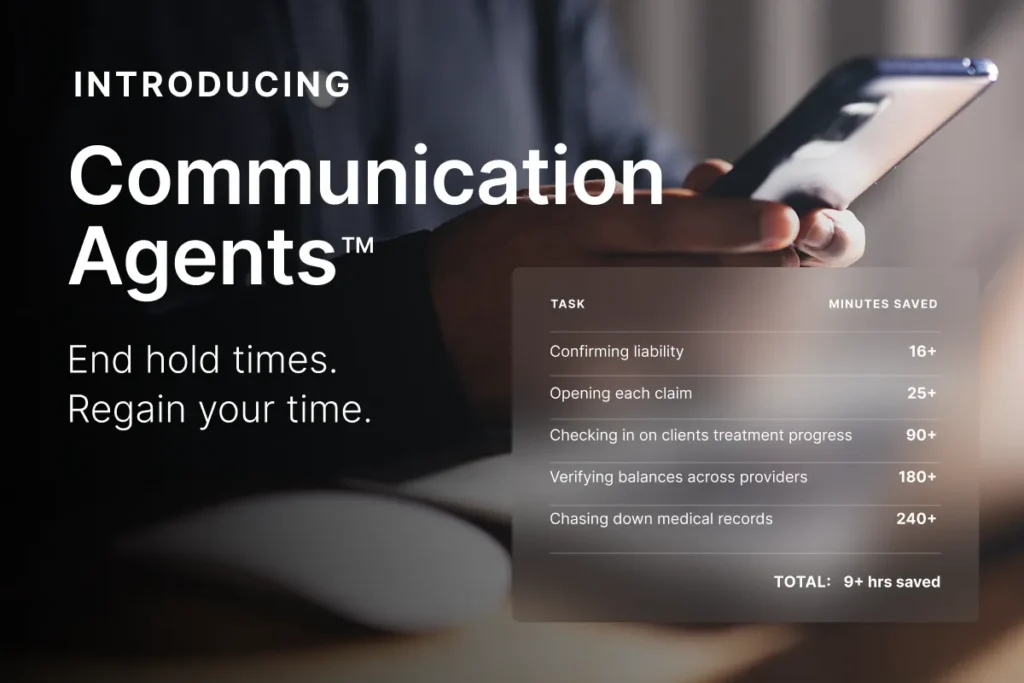
The biggest operational challenge for personal injury firms is not winning cases. It is moving them. If you are learning how to run a personal injury law firm that actually scales, start there. Cases rarely lose value in the courtroom. They lose value while everyone waits on records, inefficient processes, and cracks in workflows.
Every stalled file looks the same. A case manager is chasing a provider. A demand sits half-drafted. A treatment gap is widening unnoticed. The work is not hard. It is manual, repetitive, and endless. It is also the exact work that defines a new operating model for PI firms, one where removing the drag matters more than adding people.
This guide breaks down five bottlenecks that limit most PI firms. It also shows where AI now removes each one across the case lifecycle.
Records sit in third-party hands. Providers respond slowly. Staff spend hours faxing, calling, and re-requesting the same documents.
This is the work that fills a case manager’s day. It is also the work that adds no legal value. A file cannot advance until the records arrive. How to streamline medical records retrieval is critical for advancing firm efficiency and freeing up staff for more impactful work.
AI changes the starting point. When a case enters the case management system, the system reviews it, flags missing records, and requests them automatically. EvenUp’s approach to AI-enabled intake optimization means case managers open a staged file, not an empty one. When AI Communication Agents™ then chase providers proactively across every case at once, that follow-up stops being a person’s full-time job, which is how firms report expanding operational capacity 2.5x in the first 90 days.
Treatment gaps weaken cases. A client who stops treating for weeks undercuts the causation story. Adjusters notice, and they discount the offer.
Most firms catch these gaps too late. By the time someone reviews the file, the client has already dropped off care. The full mechanics of how treatment gaps reduce settlements, and why detection speed matters so much, are worth understanding, because a gap caught in week one is a phone call and a gap caught at demand is a permanent discount.
AI monitors each case as treatment progresses. It surfaces missing bills and gaps on a real-time care timeline. Teams intervene before value slips away.
Demand drafting is the classic bottleneck. Assembling one demand can take days of manual work. Every delay pushes settlement further out.
The stakes are measurable. EvenUp’s own data shows its winning demand packages are 69% more likely to reach policy-limit settlements. AI Drafts™ generates demand packages in minutes, in your firm’s exact tone and standards. Attorneys review instead of build. The pipeline keeps moving.
Every case manager works a little differently. Quality swings from file to file. Two similar cases can settle for very different amounts.
That inconsistency stays invisible until a case underperforms. By then, the pattern is hard to trace and harder to fix. It also carries a cost most firms never connect to process: consistently strong, well-prepared files change how carriers evaluate your firm over time, which shapes offers before any single case is priced.
AI applies the same standard to every matter. The highest-leverage move is capturing the best practices of your best people as explicit firm standards, so tools like Companion™, EvenUp’s legal AI assistant, surface the same facts and checks on every case. Best practices stop living in one person’s head.
Growth usually means hiring. More cases demand more staff, and margins shrink. Capacity becomes the ceiling on ambition.
Firmwide capacity breaks that link. EvenUp works across more than 10,000 cases a week for over 2,000 firms, including 30% of the top 100 PI firms in the country. When AI agents absorb the repetitive work across every case and the platform surfaces where cases slow, leaders can add volume without adding proportional headcount. This is why the future of law firm hiring looks less like adding seats and more like adding capacity. See the results at McCready Law.
Operational drag is not one big problem. It is five small ones repeating on every file. Record chasing, treatment gaps, slow demands, uneven handling, and capacity ceilings all compound quietly.
AI does not replace your team. It removes the rote work that buries them, which is where personal injury AI is headed: from tools your team operates toward agents that carry the work. What is left is faster cases, steadier quality, and room to grow.
Want to see where the bottlenecks live in your firm? Schedule a call with EvenUp.