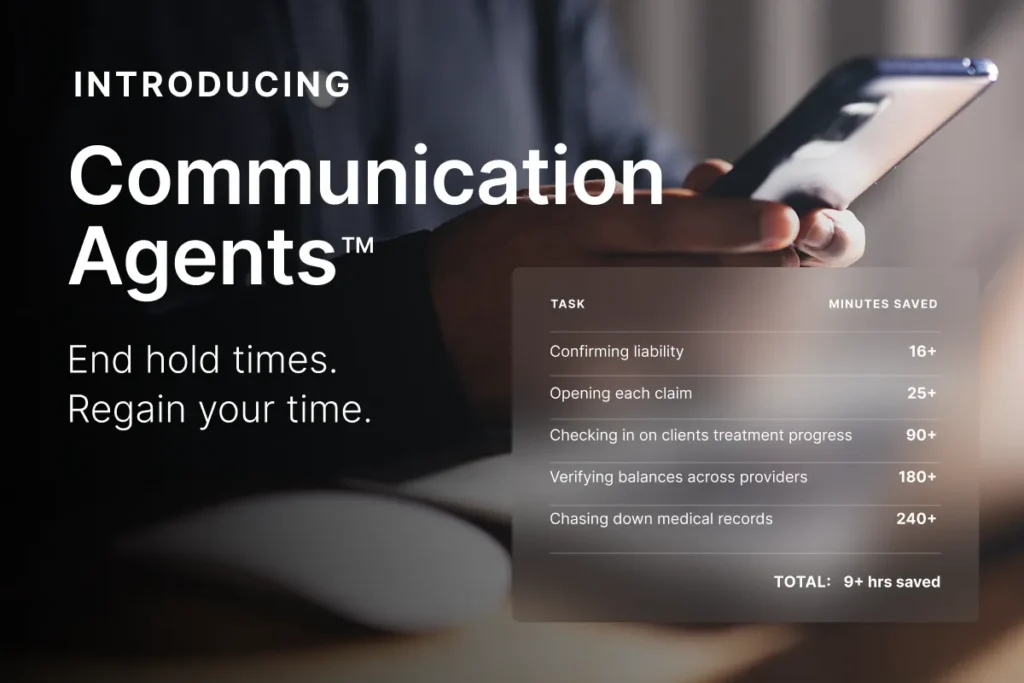
Legal AI agents are software systems that autonomously complete multi-step tasks across your caseload. They do not just answer questions or suggest next steps. They take action: calling insurers, texting clients, retrieving claim numbers, and logging every interaction to the case file. For personal injury firms, this distinction matters more than any other.
General-purpose legal AI tools excel at research, drafting, and analysis. They make good lawyers faster. But personal injury is operationally different. Pre-litigation work is a grind of repetitive phone calls: opening claims, chasing medical records, checking on treatment. These tasks do not require legal reasoning. They require consistent execution at scale. That is where PI-specific AI agents create real leverage, enabling sustainable scale without the need to equally expand head count.
This guide explains what legal AI agents are, how they differ from chatbots and copilots, and what they can do for personal injury firms today. You will also learn how to evaluate safety, accuracy, and implementation for your practice.
An AI agent in legal is software that performs multi-step tasks on behalf of your firm. It operates with autonomy that goes beyond simple automation. An agent can receive a trigger, plan a sequence of actions, execute those actions, and adapt based on results.
Consider the difference between a calendar reminder and an assistant who rebooks your meeting. The reminder tells you something. The assistant does something. Legal AI agents fall into the second category. They execute.
In practice, this means an agent can call an insurance company, navigate the phone tree, provide policy information, retrieve a claim number, and log that number to your case management software. Your staff does not touch the task. The agent handles it from trigger to completion.
Chatbots answer questions. You ask, they respond. They are reactive and conversational. Most legal chatbots help with research or client intake. They require a human to act on the information they provide.
Copilots assist with complex work. They draft documents, suggest edits, and surface relevant precedents. Tools that help you write demand letters fall into this category. Copilots accelerate human work. They do not replace the human in the loop.
Agents operate differently. They take action without waiting for instruction at each step. An agent assigned to open insurance claims will call the carrier, complete the conversation, and update your case file. You review the result. You do not manage the process.
The distinction is autonomy. Chatbots and copilots augment human decisions. Agents execute tasks end-to-end, freeing your staff for work that requires judgment.
Personal injury pre-litigation runs on phone calls. Opening claims. Confirming liability and coverage. Following up on medical record requests. Checking in with clients about treatment. Verifying balances and liens. These tasks consume thousands of hours at any firm with volume. AI agents can now handle them.
Voice and text agents call insurers to open claims, retrieve claim numbers, and confirm assigned adjusters. They call back to verify liability acceptance and policy limits. They request written confirmation. In early EvenUp deployments, firms saved roughly 92 support-staff call hours per 10 cases across these communications.
Treatment check-ins represent one of the highest-value agent applications. Clients need regular contact to stay on track with appointments. Agents send recurring texts and calls to check on treatment progress. They flag clients with no upcoming appointments, missed past appointments, or issues to discuss.
At one firm, automated treatment check-ins scaled across 2,000 active cases. About 37% of clients flagged an issue needing follow-up. Without the agent, those issues would have gone undetected until the case manager reached out manually.
Balance and lien verification is another major time sink. Agents call providers and lienholders for itemized balances, payoff figures, and check-payable information. Record status follow-up, now in early access, automates calls to providers checking on records requests. Every conversation is transcribed, summarized, and logged to the case timeline. Daily digests and real-time alerts flag cases needing human attention.
The pattern is consistent. Agents handle repetitive, rule-based communications. Humans focus on clinical interpretation, client relationships, and strategy. This is not about replacing paralegals. It is about removing the tasks that prevent them from doing higher-value work. Firms gain capacity without adding headcount.
Safety depends on task selection. Legal AI agents perform best on structured, repetitive communications with clear success criteria. Opening an insurance claim has a defined outcome: you get the claim number or you do not. Treatment check-ins follow a script. Balance verification retrieves specific figures.
These are not tasks requiring legal judgment. They are operational tasks requiring consistency. Case managers keep clinical interpretation, escalation decisions, and client strategy. Agents handle the volume that would otherwise bury your staff in routine calls.
Data security is critical. EvenUp maintains SOC2 and HIPAA attestations protecting client data. Every agent conversation is logged and auditable. Transcripts and summaries flow directly to the case timeline. Your team sees exactly what the agent said and heard.
Accuracy improves with domain specificity. General-purpose AI tools struggle with personal injury workflows because they lack context. PI-specific agents are built on medical record review pipelines, case management integrations, and insurance carrier protocols. They know the domain.
Start with routine, high-volume tasks. Treatment check-ins and claim openings are good entry points. They are repetitive, have clear success criteria, and don’t require legal judgment. If something goes wrong, the downside is limited.
Measure before and after. Track how many hours your staff spends on these communications. Compare that to agent performance. In early EvenUp deployments, firms documented roughly 92 support-staff call hours saved per 10 cases. Your numbers will vary based on case mix and current workflows.
Expand across the lifecycle as confidence grows. Move from claim openings to liability confirmation to balance verification. Build a portfolio of agent-managed tasks. Each addition frees more staff time for judgment-intensive work.
Integration matters. Agents work best when connected to your case management system. Updates should flow automatically to the case timeline. Your team should not re-enter data the agent already captured.
The best agents match your practice area. General-purpose tools like Harvey lead the market for research and drafting. For personal injury, look for agents built on PI-specific data and workflows. EvenUp’s Claims Intelligence Platform, powered by Piai and a 250K+ verdict and settlement dataset, is trusted by more than 2,000 firms, including 30% of the top 100 PI firms.
No. Agents handle repetitive communications that consume staff time. Paralegals and case managers retain clinical judgment, client relationships, escalation decisions, and strategy. Agents free your staff to focus on work that requires human expertise.
Security varies by vendor. EvenUp maintains SOC2 and HIPAA attestations. All agent conversations are transcribed, logged, and auditable. Evaluate any vendor’s data handling, storage, and compliance certifications before implementation.
Results depend on case volume and current workflows. In early EvenUp deployments, firms saved roughly 92 support-staff call hours per 10 cases. These figures represent beta findings, not guaranteed outcomes.
Legal AI agents are still early. The personal injury firms adopting them now are building operational advantages that will compound over time. As agents expand across more task types, the gap between early adopters and laggards will widen.
The trajectory is clear. Today, agents handle claim openings, treatment check-ins, and balance verification. Tomorrow, they will manage more of the case lifecycle. Firms that build comfort with agent-assisted workflows now will scale faster as capabilities expand.
EvenUp processes more than 10,000 cases a week, representing over $14 billion in damages. That scale creates feedback loops that improve agent accuracy and expand task coverage. The firms on the platform benefit from every improvement.
If you want to see how AI agents can work for your firm, schedule a call with EvenUp.