Emotional distress is the most under-documented component of most personal injury demands, and under-documented is what makes it under-valued. The economic damages in a file assemble themselves: bills, wage records, receipts. The emotional harm does not, and adjusters discount what is not documented.
This guide covers how emotional distress damages are calculated, what drives values up or down, what the evidence has to show, and how firms build the record that supports the number they demand.
On-demand webinar about how building your own AI stack means owning every risk that comes with it. A 26-minute look at what general-purpose AI actually costs a PI firm.
Watch Webinar
Emotional distress damages cover anxiety, depression, PTSD, insomnia, and related psychological harm. The question that matters for valuation is which claim framework applies, because that changes both the burden and the documentation strategy.
Standalone emotional distress claims exist in most jurisdictions. Some states require physical contact under the impact rule. Others allow claims based on zone of danger or foreseeability alone.
The framework also shapes the evidence. PI emotional distress claims anchor to a single traumatic event. Employment claims such as harassment or discrimination often arise from a pattern of conduct. Each demands a different documentation approach and produces different negotiation dynamics.
The IIED/NIED distinction is not academic. It directly affects documentation strategy and negotiation leverage.
| IIED (Intentional Infliction) | NIED (Negligent Infliction) | |
|---|---|---|
| Definition | Defendant acted intentionally or recklessly to cause severe emotional harm | Defendant’s negligence caused emotional distress as a byproduct |
| Burden of Proof | Must show conduct was “extreme and outrageous” | Must show defendant breached a duty of care |
| Common Scenarios | Threats, stalking, deliberate humiliation, egregious employer conduct | Car accidents, medical malpractice, premises liability |
| Typical Settlement Impact | Higher multipliers due to intentional conduct. Punitive damages may apply. | Standard multipliers. Compensation tied to negligence severity and evidence strength. |
For PI attorneys, NIED claims are far more common. The burden of proof is lower, but documentation requirements are higher, because the emotional harm has to be clearly linked to the negligent act.
See how a claim is built for negotiation: the facts that establish value, the arguments an adjuster will raise, and the documented rebuttals that answer them.
Download Sample Negotiations Sheet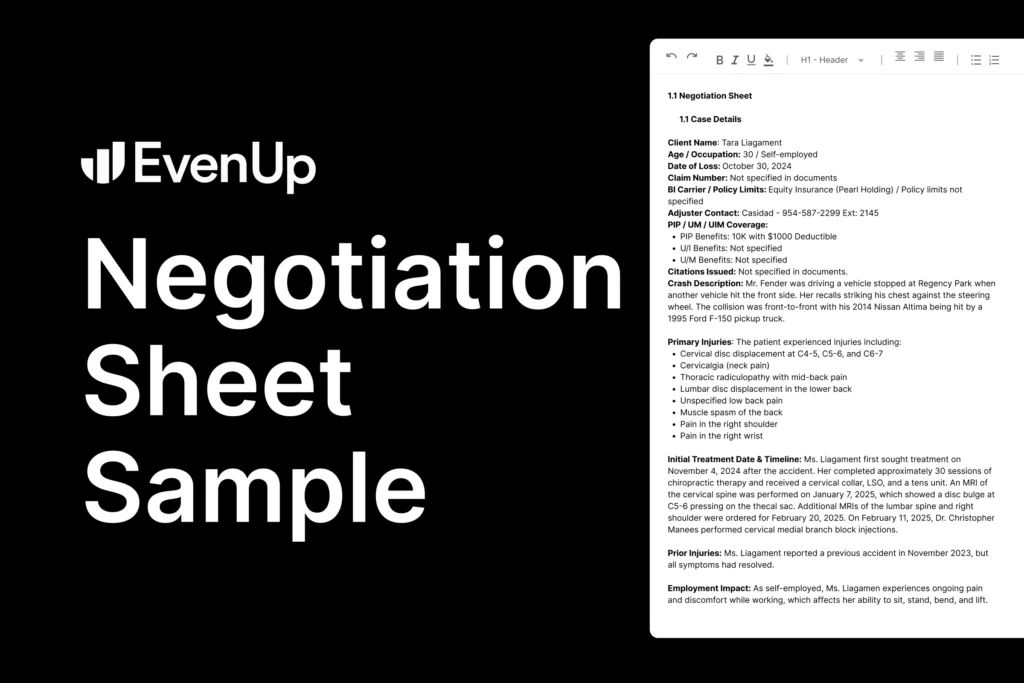
Two methods dominate, and both depend entirely on the quality of the underlying record.
The multiplier method ties non-economic damages to the claimant’s economic losses. Calculate total economic damages (medical bills, therapy costs, lost wages), then apply a multiplier, typically ranging from around 1.5 for mild, short-term distress to 5 or higher for severe, life-altering conditions.
What supports a higher multiplier:
The method is widely used and inherently subjective, which is why adjusters push for lower multipliers. The counter is documentation, since every factor above is either in the record or it is not.
The per diem method assigns a daily dollar value to emotional suffering and multiplies it by the number of days the claimant experienced distress. If a claimant suffered documented anxiety for 18 months following an accident, assigning $150 per day yields roughly $82,000 in non-economic damages.
Per diem works best when medical records show a defined arc of suffering, which makes the treatment timeline the load-bearing evidence. A medical chronology built from the raw records shows exactly when symptoms began, peaked, and resolved, and that timeline is what a per diem calculation rests on.
Thorough documentation is the foundation. Collect records from therapists, psychiatrists, and primary care physicians detailing diagnosis, treatment plan, and prognosis, and connecting the distress to the incident.
Witness statements from family, friends, or colleagues who observed behavioral changes add significant weight. Changes in sleep patterns, social withdrawal, or inability to work demonstrate real-world impact. Converting raw records into a structured, litigation-ready treatment timeline is what makes that evidence usable rather than merely present, and it is where MedChrons removes hours of manual review.
Expert testimony from mental health professionals validates the claim. A qualified expert can assess the extent of distress, explain the diagnosis in terms a jury or adjuster understands, and project long-term implications, translating clinical findings into concrete life impact.
Physical injury is not a prerequisite for emotional distress compensation in most jurisdictions. Anxiety, depression, and insomnia are legally compensable when supported by medical evidence and testimony.
Focus on real-world consequences: how the distress affected the claimant’s ability to work, maintain relationships, or perform daily tasks. This is the section of a demand most often written thinly, and AI drafting can generate it from the documented record rather than from a template, so the narrative is tied to evidence.
Demands don’t just tell a story—they build a case. See how EvenUp demands provide a 69% higher likelihood of tendering policy limits.
Download Sample Demand
Severity and duration. More intense and prolonged suffering supports higher compensation. Chronic PTSD lasting years is documented differently than a short period of mild anxiety. Document the timeline and its trajectory.
Physical symptoms and medical evidence. Emotional distress often manifests physically through headaches, digestive problems, fatigue, and insomnia. Document every physical symptom and its connection to the emotional harm.
Evidence strength. The claim lives or dies here. Medical records, therapist evaluations, witness testimony, and expert opinions must establish a clear causal link between the conduct and the suffering. This is also where treatment gaps do the most damage, since a break in psychological care invites the argument that the distress resolved.
Jurisdiction. State laws vary significantly. Some follow the impact rule, others apply zone of danger or foreseeability standards, and damage caps may limit non-economic compensation. Confirm the requirements in your jurisdiction before building case strategy.
The evidence most attorneys overlook is contemporaneous symptom documentation. Therapist notes and psychiatric evaluations carry weight, but a daily log of anxiety episodes, sleep disruptions, and functional limitations creates a real-time record that adjusters struggle to dismiss. Paired with witness statements from people who saw behavioral changes firsthand, the combination of clinical records and lay testimony is harder to attack than either alone.
Strong medical evidence gives an objective basis for evaluating a subjective claim. Documented therapy sessions, medication prescriptions, and mental health visits demonstrate seriousness in a form an adjuster can verify. The practical obstacle is volume: psychological treatment records accumulate across providers and months, and assembling them at demand prep is where firms lose both time and detail. Continuous medical record review keeps that record current instead.
Then present it deliberately. Organize the evidence logically, highlight key findings, and use visuals where possible so the reviewer can follow the arc without reconstructing it.
Every emotional distress claim is subject to a filing deadline. In most states, the statute of limitations ranges from one to three years from the date of the incident, and missing it bars the claim regardless of merit.
The discovery rule is the main exception. In some jurisdictions the clock starts when the claimant knew or should have known about the emotional harm, which matters when PTSD or a related condition emerges months after the triggering event.
State-by-state variation is significant. Verify the applicable deadline in your jurisdiction before filing.
The obstacle is rarely knowing what to document. It is doing it consistently across a full caseload, on the cases where nobody is looking closely.
Emotional distress documentation degrades quietly. A client stops attending therapy and nobody notices for two months. Provider records arrive incomplete and the gap is discovered at demand prep. The functional-impact detail that would have supported the claim was never captured because no one asked at the right time. None of those are strategy failures. They are coverage failures, and they scale with caseload.
That is what makes this a systems problem. When treatment is monitored continuously across every case rather than reviewed at the end, a lapse in psychological care surfaces while it can still be addressed. When records are structured as they arrive, the emotional-harm timeline exists before the demand is drafted rather than being reconstructed under deadline. Firms working this way report meaningful capacity gains, including nine or more hours of staff time recovered per case, and that recovered time is what makes thorough documentation feasible on every file instead of the handful that get attention.
Attorneys using EvenUp Demands see a 69% higher likelihood of policy-limit settlements. The demand amount remains the firm’s decision. What changes is whether it rests on a complete record.
Emotional distress is not undervalued because adjusters refuse to pay for it. It is undervalued because it arrives at the negotiation with less evidence behind it than every other element of the claim.
The firms that consistently do better on this component are not using a different formula. They document psychological treatment as rigorously as physical treatment, catch lapses in care while they can still be explained, and build the functional-impact record contemporaneously rather than reconstructing it at demand time. The calculation method matters far less than what you can prove.
Schedule a call to see how EvenUp helps firms document emotional distress across every case.
Schedule a call today to see how EvenUp’s AI tools automate repetitive tasks, streamline custom drafting, and empower staff to focus on case strategy and client engagement.
Schedule a Call
Settlement amounts can range from $10,000 for mild, temporary distress to $500,000 or even millions of dollars for severe, chronic conditions. The outcome depends on evidence strength, jurisdiction, and how effectively the demand quantifies suffering. Attorneys using data-driven demand packages built with tools like EvenUp Demands consistently achieve higher valuations.
Yes, in most jurisdictions. IIED claims allow recovery for purely emotional harm caused by extreme and outrageous conduct. Some states also permit standalone NIED claims under certain circumstances. Requirements vary by state, so check your jurisdiction’s specific rules.
Most cases settle within 6 months to 2 years. Timeline depends on evidence complexity, the defendant’s willingness to negotiate, and whether litigation is required. Strong documentation and data-backed demands tend to accelerate resolution.
Contemporaneous documentation is the strongest: therapist and psychiatric records, a daily log of symptoms and functional limitations, and witness statements from people who observed behavioral changes. The combination of clinical records and lay testimony is harder to challenge than either alone.